
Last Updated on June 30, 2026 by Mark Allen
Can Ragdolls Be Left Alone? 5 Honest Truths Every Owner Must Know
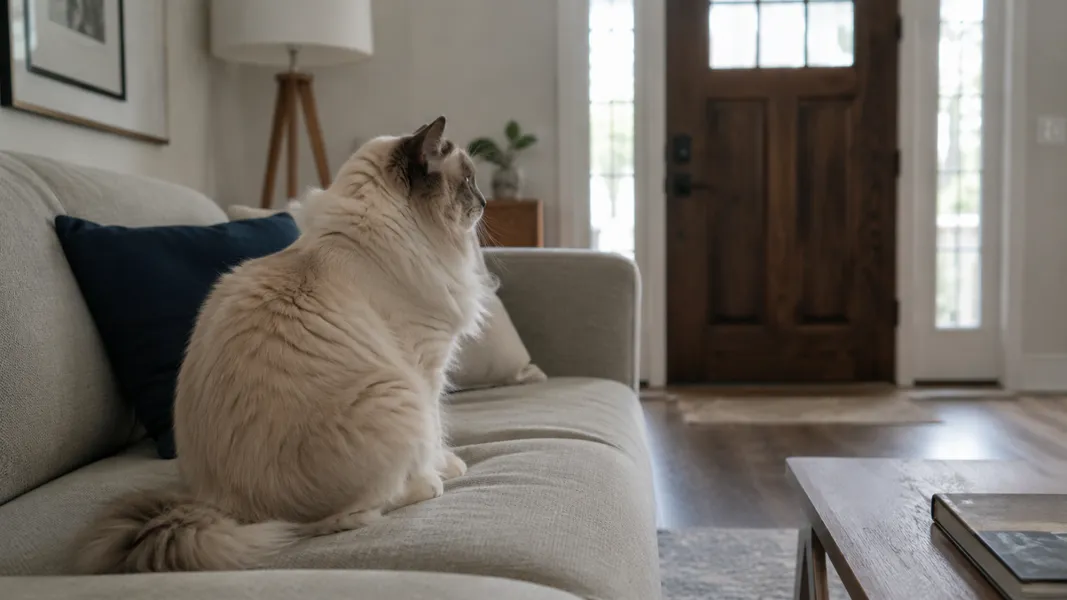
Ragdolls can be left alone for reasonable periods, but they are among the least suited domestic cat breeds for extended daily isolation. The honest answer to this question sits between two extremes — Ragdolls are not so fragile that a working owner cannot successfully keep one, but they are genuinely not suited to the benign neglect that more independent cat breeds tolerate without difficulty.
The Ragdoll’s intense social orientation — the same quality that makes them such outstanding companions when you are present — means they experience your absence more acutely than most cats. They are not aloof cats that go about their day indifferently while waiting for you to return. They are people-bonded cats who notice your absence, respond to it with varying degrees of behavioral change, and genuinely benefit from thoughtful management of time alone. If you are still deciding whether this breed suits your working lifestyle, the pros and cons of Ragdoll cats guide lays out the full picture including how their social nature affects daily ownership.
This guide covers exactly how long different age groups can safely stay alone, what separation anxiety actually looks like in this breed, and the most effective products and strategies for keeping a Ragdoll home alone comfortable, fed, hydrated, and mentally engaged throughout a standard working day.
How Long Can a Ragdoll Safely Stay Alone?
The answer varies significantly by age and individual temperament.
Ragdoll Kittens
Ragdoll kittens under six months should not be left alone for more than four hours. Their small bladder capacity requires more frequent litter box access, their developing immune systems benefit from consistent human monitoring, and their emotional development during this period is significantly shaped by the security of consistent human contact. A kitten left alone for a full working day repeatedly during this developmental window is more likely to develop anxious attachment patterns as an adult than one with more consistent human presence. Investing in the right litter box setup from the start ensures a kitten’s physical needs are well managed even during shorter absences.
Adult Ragdolls
Healthy adult Ragdolls between one and ten years can tolerate a standard eight-hour working day alone if the environment is properly enriched. This is the realistic expectation — not comfortable, but manageable with the right setup. Most Ragdolls in working households adapt to this schedule once it becomes predictable and consistent. What they struggle with most is unpredictability — an owner who is sometimes home, sometimes away for two hours, and occasionally away for twelve creates more anxiety than one whose schedule is a reliable eight-hour daily absence. Beyond eight hours, most Ragdolls begin showing behavioral signs of distress that affect the next day’s behavior even after the owner returns. Days extending past ten to twelve hours represent a meaningful welfare concern for this breed specifically.
Senior Ragdolls
Senior Ragdolls over ten years have often established comfortable routines and sleep more, making long absences more manageable behaviorally. However, their health needs — more frequent small meals, increased hydration requirements, potential medication schedules — mean they require more practical support during absences rather than less. Automatic feeders and water fountains become particularly important for senior cats left alone. Understanding how to feed a Ragdoll correctly across life stages ensures their nutritional needs are met even when you are not home to monitor them.
Why Ragdolls Struggle With Being Alone
Emotional Attachment to Specific People
Ragdolls do not generalize their attachment across all humans equally — they typically bond most strongly with one or two specific household members and experience the absence of those individuals specifically. This specificity means that the presence of a houseguest, another cat, or a second owner does not fully substitute for the absent primary attachment figure in the way it might for a more socially flexible breed. The same attachment quality is explored in detail in the guide on why Ragdolls are so clingy, which covers the genetic and behavioral roots of this owner-bonding tendency.
Need for Stimulation
The Ragdoll’s intelligence, which contributes to their ability to learn routines and respond to their owners with apparent understanding, also means they get bored more readily than less intelligent breeds. A bored Ragdoll alone is more likely to develop unwanted behaviors than a bored cat of a less cognitively engaged breed. Environmental enrichment is not optional for this breed — it is a welfare requirement. The best toys for Ragdoll cats guide covers the enrichment options that work best for the Ragdoll’s specific intelligence level and play preferences. For a fully interactive setup, the best interactive toys for Ragdoll cats guide published alongside this series covers automated options specifically designed for solo play.
Boredom and Stress Escalation
A Ragdoll that exhausts its enrichment options within the first two hours of an eight-hour absence spends the remaining six hours in understimulated, potentially anxious waiting. This cumulative stress across a full working week produces the behavioral changes — increased clinginess when you return, interrupted sleep patterns, reduced appetite, stress grooming — that are often misread as personality quirks rather than responses to inadequate enrichment. Setting up a dedicated safe space within your home gives your Ragdoll a reliable retreat that reduces anxiety accumulation throughout the day.
Signs Your Ragdoll Has Separation Anxiety
These signs, when consistent and specifically occurring around your departures and returns, indicate separation anxiety rather than normal Ragdoll independence challenges:
Excessive vocalization around departure cues — picking up keys, putting on shoes, putting on a coat. Your Ragdoll has learned these signals and responds with increasing distress vocalizations before you have even left.
Destructive scratching at doors — particularly at the door you exit through, or at the door to rooms where they are confined during absences.
Stress grooming — over-grooming to the point of hair loss, particularly on the belly, inner legs, or base of tail, that develops or worsens in correlation with isolation periods.
Appetite changes — consistently refusing to eat meals dispensed during your absence that they eat normally when you are present.
Overexcited greeting behavior — greeting you on return with an intensity disproportionate to the length of absence, often combined with extended vocalization, that takes longer than five to ten minutes to settle.
How to Keep a Ragdoll Happy While You Are Away
Automatic Feeding
Maintaining a consistent feeding schedule during absences removes one source of anxiety — hunger — and creates a predictable positive event that breaks up the waiting period. Automatic feeders that dispense at programmed times allow a Ragdoll to have meals on schedule regardless of your return time. Pairing a good feeder with the best cat food for Ragdolls ensures the meals dispensed during your absence are genuinely nutritious and satisfying.
Hydration
Cats that are stressed drink less water — a compounding problem during long absences. Moving water from a fountain encourages consistent drinking even when the cat is mildly stressed, and the sound of flowing water provides low-level environmental stimulation. Ragdolls that tend to avoid still water will drink more consistently from a fountain — the do Ragdoll cats like water guide explains this preference in more detail.
Entertainment and Toys
Rotating two to three automated or enrichment toys — a motion-sensor ball, a feather wand under a concealment skirt, a multi-level track ball system — gives the Ragdoll independent activities that do not require your involvement. No single toy holds a Ragdoll’s attention for an entire working day, but a variety positioned around the home creates multiple engagement opportunities across the absence period.
Climbing Furniture
A cat tree positioned near a window giving outdoor views is one of the highest-value solo enrichment setups for a Ragdoll home alone. Watching birds, traffic, and environmental movement provides hours of stimulation that requires no manufactured toy involvement. The best cat trees for Ragdoll cats guide covers size-appropriate options for this large breed that provide both window access and multi-level climbing.
Monitoring With Pet Cameras
A pet camera that allows two-way audio interaction lets you check in during the day and speak to your Ragdoll — activating their attachment security response even from a distance. The best pet cameras for Ragdoll cats guide covers the top monitoring options with a detailed comparison of features that matter specifically for this breed.
Best Products for Ragdolls Left Alone
PETLIBRO RFID Automatic Cat Feeder — Best Feeder for Ragdolls Left Alone
Maintaining a consistent feeding schedule during your absence is one of the most concrete steps you can take for a Ragdoll left alone, and the PETLIBRO RFID Automatic Feeder is the most technically advanced option in this guide. The RFID collar tag system identifies your specific cat and opens the food bowl lid exclusively for that cat — preventing food stealing in multi-pet households and ensuring each cat’s portion is controlled accurately. The dual-band WiFi (2.4GHz and 5GHz) connects to the Petlibro app for real-time feeding monitoring and diet tracking, so you can confirm from work that your Ragdoll ate their scheduled meal.
The 5-layer freshness protection system — sealed lid with silicone gaskets, desiccant bag, airtight rotor, and RFID-controlled bowl lid — keeps dry food fresh across the full day’s absence. The 3L capacity provides approximately two weeks of feeding for a single adult Ragdoll without refilling. For guidance on which dry food to load into this feeder, the best cat food for Ragdoll cats guide provides vetted recommendations.
Key Features
- RFID collar tag identification for personalized meal access
- Dual-band WiFi with app-based diet tracking
- 5-layer freshness protection system
- 10 scheduled meals per day up to 48 portions each
- Stainless steel bowl
- 3L capacity
Pros
- RFID identification prevents food stealing in multi-cat homes
- Real-time feeding confirmation via app from anywhere
- Consistent scheduled meals reduce anxiety during absences
- Freshness system maintains food quality across full working days
Cons
- Requires RFID collar tag — some cats resist wearing collars
- WiFi connectivity issues noted in some user reviews
Best For: Ragdoll owners in multi-pet households or those who want feeding confirmation during work absences.
WOPET 6L Automatic Cat Feeder — Best Value Feeder for Ragdolls Alone
The WOPET 6L Automatic Feeder offers a straightforward, affordable solution for scheduled feeding during Ragdoll absences — without the premium RFID identification system of the PETLIBRO but with a larger 6L capacity that suits households where refilling frequency matters. The WiFi app control via “WOpet Life” allows remote scheduling and monitoring from iOS or Android, and the 10-second voice recording feature plays a personalized message at mealtimes — your familiar voice providing a small but meaningful comfort signal during your absence.
Up to 15 meals per day with 1-50 portions per meal accommodates a wide range of feeding schedule options, and the dual power supply — adapter plus battery backup — ensures feeding continues during power interruptions. The safety locks prevent a determined Ragdoll from accessing the food container between scheduled meals.
Key Features
- 6L large capacity
- WiFi app control with 15 meals per day scheduling
- 10-second voice recording for personalized meal announcement
- Dual power supply with battery backup
- Safety locks on container and lid
- Low food sensor notification
Pros
- Large capacity reduces refilling frequency
- Voice recording feature provides comfort signal during absences
- Battery backup prevents feeding disruption during power outages
- App family sharing allows multiple household members to monitor
Cons
- 2.4GHz WiFi only — does not support 5GHz
- Bowl may be small for very large adult male Ragdolls
Best For: Single-cat Ragdoll households wanting reliable scheduled feeding at a more accessible price point.
Furbo 360° Cat Camera — Best Monitoring Solution for Ragdolls Left Alone
For owners who need to monitor a Ragdoll during long absences — and particularly for those managing separation anxiety — the Furbo 360° Camera bundle provides the most complete remote monitoring and interaction capability available. The two-camera bundle covers multiple rooms, the 360° rotation eliminates blind spots, and the two-way audio allows you to speak to your cat during the day — a meaningful intervention for separation anxiety that activates the cat’s attachment security response through the familiar voice even without physical presence.
The Kitty Diary documents activity patterns throughout the day, giving owners data on whether their Ragdoll is resting, playing, or showing signs of distress during specific periods. This behavioral data is genuinely useful for evaluating whether enrichment interventions are working over time. For a full side-by-side comparison of the Furbo against other monitoring options, the best pet cameras for Ragdoll cats guide provides detailed analysis.
Key Features
- Two-camera bundle for multi-room coverage
- 360° rotation with 4X HD zoom
- Two-way audio for remote vocal interaction
- Kitty Diary with daily activity documentation
- 3-7 days video history with Nanny subscription
- Real-time smart alerts
Pros
- Two-way audio is the most effective remote anxiety intervention available
- Multi-room coverage eliminates the unknown about what your cat is doing
- Activity pattern data helps evaluate enrichment effectiveness over time
- Subscription includes regular feature updates
Cons
- Nanny subscription required for full functionality
- 2.4GHz WiFi only
Best For: Owners of Ragdolls with separation anxiety who need monitoring and remote interaction capability during work absences.
PetSafe Drinkwell Pagoda Ceramic Fountain — Best Hydration for Ragdolls Left Alone
Hydration management during long absences is more important for Ragdolls than many owners realize. A stressed cat drinks less water, and a dehydrated cat is at higher risk for urinary tract issues — a known Ragdoll health concern. The PetSafe Drinkwell Pagoda provides two levels of free-falling water streams that encourage drinking through movement and sound, with a 70 oz / 2L ceramic bowl capacity appropriate for a full working day without refilling.
The ceramic construction is non-toxic, scratch-resistant, and hygienic in a way that plastic alternatives are not — important for a product in use continuously across multiple daily absences. The carbon and foam filter combination keeps water fresh and hair-free throughout the day. The elevated tiered design is particularly suitable for Ragdolls, whose large size makes the standard low bowl position less comfortable for drinking than an elevated option.
Key Features
- 70 oz / 2L ceramic capacity
- Two levels of free-falling water streams
- Carbon filter for freshness plus foam filter for hair debris
- Elevated tiered design for comfortable access
- Premium ceramic construction
- Open bowl backup access during power loss
Pros
- Ceramic construction is more hygienic than plastic for continuous daily use
- Two free-falling streams encourage drinking even in mildly stressed cats
- Elevated design suits the Ragdoll’s large body for comfortable drinking posture
- 12 carbon filters plus 2 foam filters included in premium bundle
Cons
- Higher price point than plastic fountain alternatives
- Ceramic weight makes moving between rooms less convenient
Best For: All Ragdolls left alone during working hours, particularly those with known urinary health concerns.
Gitelsnour Maine Coon Cat Tree — Best Climbing Solution for Ragdolls Left Alone
Designed specifically for large breeds — the listing explicitly cites 20 lbs+ cats and Maine Coons — this 68.5-inch heavy duty cat tree is one of the most appropriate vertical enrichment solutions for Ragdolls spending a full working day alone. The two wooden perches at different heights with cushioned surfaces, two large condos measuring 15.7″ x 17.7″, 15 sisal scratching posts, and a deep hammock provide the variety of resting and activity zones that keeps a solo Ragdoll occupied across multiple hours without requiring a single consistent activity.
The 27.6″ x 17.7″ wide base with anti-tipping strap addresses the stability concern that is paramount for a large Ragdoll using a cat tree unsupervised — a tip event during an eight-hour absence is a welfare and safety concern that a wide base design substantially mitigates. Positioning this tree near a window with outdoor view creates the single most effective unsupervised enrichment setup available for a Ragdoll home alone. For more large-breed-appropriate options, the best cat trees for Ragdoll cats guide provides a full category comparison.
Key Features
- Designed for large breeds 20 lbs and above
- 68.5 inches tall
- 2 wooden perches with non-slip cushioned surfaces
- 2 large condos at 15.7″ x 17.7″
- 15 sisal scratching posts
- Deep fabric hammock
- Wide 27.6″ x 17.7″ anti-tip base
Pros
- Explicitly designed for large breed cats — appropriate dimensions for adult Ragdolls
- Wide base with anti-tip strap for unsupervised safety
- Multiple zone variety maintains engagement across a full day
- Removable and detachable fabric cover for maintenance
Cons
- High shipping cost from Pakistan
- Assembly time investment
Best For: Ragdolls spending extended unsupervised periods who need a comprehensive vertical enrichment structure sized for their body.
Should You Get Another Cat for Your Ragdoll?
A second cat is genuinely beneficial for Ragdolls that spend long daily periods alone — but with important caveats. A second Ragdoll, or a similarly social and gentle breed, provides consistent companionship that automated toys cannot replicate. Studies in cat welfare consistently show that socially compatible cat pairs show fewer stress behaviors during owner absences than single cats in equivalent environments.
The caveats: the second cat must be socially compatible, the introduction must be managed gradually and carefully, and the second cat does not fully substitute for human contact for a Ragdoll with strong owner attachment. A second cat reduces boredom and provides social stimulation — it does not resolve separation anxiety directed specifically at the primary human attachment figure. The are Ragdoll cats good with dogs guide covers interspecies compatibility that may also be relevant for households considering alternative companion animals. If you want to explore breed compatibility more broadly, the comparison guides on Ragamuffin vs Ragdoll and Ragdoll vs Siamese are helpful starting points for selecting a compatible companion breed.
What We Have Covered
Throughout this complete guide to whether Ragdolls can be left alone we covered the realistic time limits by age group, why this breed specifically struggles with isolation more than average domestic cats, the specific signs that distinguish normal Ragdoll adjustment from separation anxiety, and a complete practical setup for keeping a Ragdoll comfortable during a standard working day — automatic feeding, hydration, monitoring, climbing furniture, and enrichment toys. We also covered the genuine-but-conditional value of a second cat companion.
Ragdolls can absolutely live happily in working households — millions do worldwide. Success requires thoughtful environmental setup rather than simply leaving the cat to manage alone, and the products in this guide provide the practical infrastructure that makes a working owner’s Ragdoll life genuinely comfortable for both parties. The companion guide on why Ragdolls are so clingy covers the behavioral side of this attachment in full detail. For questions about your specific situation, feel free to reach out through our contact page.
Frequently Asked Questions
How long can Ragdolls stay alone safely?
Adult Ragdolls can manage a standard eight-hour working day alone when the environment is properly enriched. Beyond ten to twelve hours, most Ragdolls begin showing behavioral distress signs. Kittens under six months should not be left alone for more than four hours.
Do Ragdolls get separation anxiety?
Some do — particularly those in households with highly variable owner schedules, insufficient environmental enrichment, or strongly bonded single-owner households. True separation anxiety produces physical and behavioral symptoms that go beyond normal waiting. The signs section above covers specific indicators.
Can a Ragdoll be happy alone with toys?
Toys reduce boredom-driven distress but do not eliminate attachment-based separation responses. A Ragdoll with varied automated enrichment is happier alone than one without, but the highest-impact intervention remains a consistent, predictable schedule combined with enrichment rather than either alone.
Is it cruel to leave a Ragdoll alone all day?
An eight-hour working absence with proper enrichment, feeding, and hydration management is not cruel for an adult Ragdoll — it is a realistic modern household arrangement. Absences consistently exceeding ten hours daily without environmental support, or leaving a kitten or senior cat alone for extended periods without appropriate care, crosses into welfare concern territory.

Hi, I’m Mark Allen. I specialize in researching and writing about Ragdoll cats, covering topics such as behavior, grooming, nutrition, health, and breed characteristics. My goal is to provide cat owners with practical, well-researched information that helps them make informed decisions and better care for their pets.

