
Flame Point Ragdoll Kittens: Growth, Color Development and What to Expect at Every Age
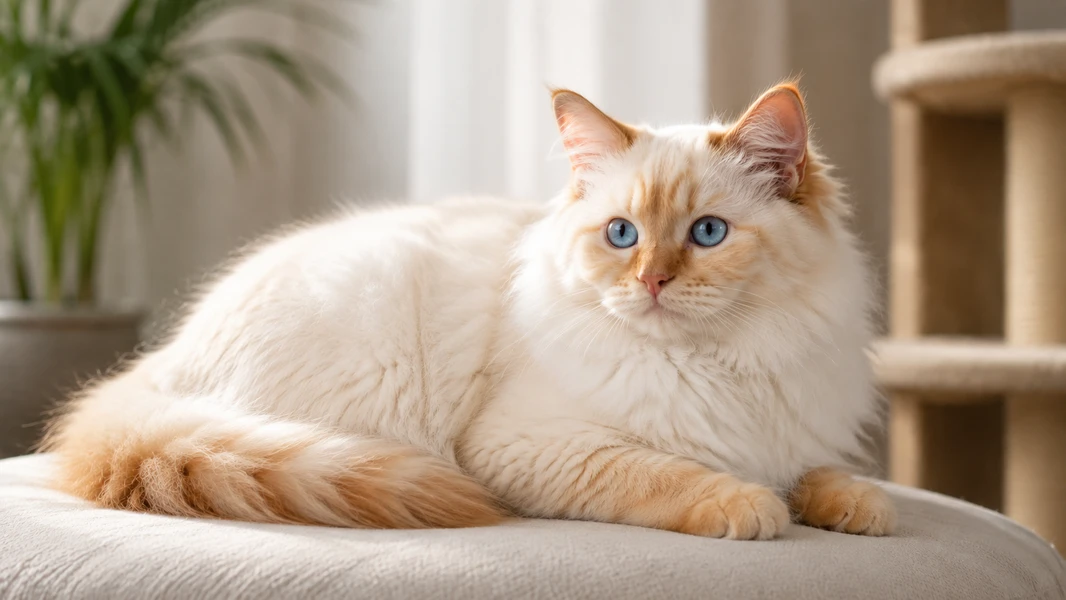
Quick Answer
Flame Point Ragdoll kittens are born almost entirely white with no visible orange or red coloring at all. The characteristic orange-red flame points begin appearing as faint warmth on the ear tips within the first two to four weeks of life, driven by the temperature-sensitive colorpoint gene that only activates pigment production in the cooler extremities. By 8 weeks the pattern outline is recognizable; by 6 months, the flame coloring is clearly established but approximately half of its eventual adult saturation, and full adult color depth is not reached until two to three years of age. Understanding this timeline prevents the common misconception that a pale kitten is the wrong color, and gives owners a realistic picture of how one of the most visually striking cat breeds in the world develops its extraordinary appearance.
At a Glance: Flame Point Ragdoll Kitten Development Timeline

Why Flame Point Ragdoll Kittens Fascinate Cat Owners
There is something genuinely extraordinary about the Flame Point Ragdoll’s developmental story. You start with what appears to be an entirely ordinary white kitten — no hint of the vivid orange-red flame coloring that makes this variety one of the most photographed cats in the world — and over the course of three years, you watch a transformation unfold that most owners describe as one of the most rewarding visual experiences in cat ownership.
I have been researching and writing about Ragdoll cats on ragdollinfo.com for several years, and the Flame Point kitten development question generates more confusion, anxiety, and fascination than almost any other topic in this breed’s catalog. New owners routinely contact breeders in the first weeks after bringing home their kitten wondering if they have somehow received the wrong cat. The kitten they imagined — vivid orange-red face mask, brilliant blue eyes, cream and flame coloring in full contrast — looks nothing like the pale, essentially white animal sitting in their lap.
The confusion is understandable. But it is also entirely unnecessary once you understand the mechanism that drives Ragdoll color development, and once you have a clear age-by-age reference for what to expect at every stage. That is exactly what this guide provides.
The complete expert guide to the adult Flame Point Ragdoll covering genetics, pattern variations, pricing, and health considerations is at the flame point ragdoll cat guide. This companion article focuses entirely on the kitten and development journey — the stages, the timeline, the growth, the temperament development, and the practical questions every Flame Point kitten owner faces in the first three years.
Why Flame Point Ragdoll Kittens Are Born White

The single most important piece of information for any Flame Point Ragdoll kitten owner is this: all standard Ragdolls are born essentially white, and the orange-red flame coloring appears and deepens gradually over years, not weeks.
This is not a defect, a health problem, or a sign that anything is wrong. It is a direct, predictable result of the temperature-sensitive colorpoint gene — written cscs in standard feline genetics notation — that all purebred Ragdolls carry in homozygous form (two copies).
The colorpoint gene produces a pigment enzyme that is heat-sensitive. The enzyme is inactivated at normal core body temperature but activates at the cooler temperatures found in the extremities — the ears, nose, paws, and tail. This means that pigment production only occurs in areas of the body that are cooler than the core, which is why Ragdoll color appears exclusively on the points and why the warmer central body remains pale.
During pregnancy, a developing Ragdoll kitten is surrounded by the mother’s body warmth, maintaining a uniform temperature throughout. Without a temperature differential between core and extremities, the colorpoint enzyme has no signal to produce pigment in the points versus the body. The result is a kitten born uniformly white or near-white — the color mechanism has not yet been triggered.
After birth, as the kitten begins regulating its own body temperature and the extremities naturally run cooler than the core, the colorpoint enzyme activates in those cooler zones and pigment production begins. Because the extremities take time to develop meaningful temperature differential from the core — and because pigment production and deposition in the hair shaft is gradual — the color takes weeks and months to become visible, and the full saturation of adult coloring takes years.
The white areas in a Flame Point Ragdoll that remain white permanently — in Flame Bicolor and Flame Mitted individuals specifically — are maintained by a separate genetic mechanism, the white spotting gene (S allele), which prevents melanocytes from settling in designated areas entirely. This is separate from the colorpoint mechanism and is why pattern markings like the inverted V in a Flame Bicolor are visible from birth as slightly brighter white areas even before surrounding color has developed.
Why Orange-Red Specifically?
The flame (orange-red) color in Ragdolls is produced by the O gene, which is sex-linked — carried on the X chromosome rather than a non-sex chromosome. This gene causes the production of phaeomelanin (yellow to red pigment) rather than the eumelanin (brown to black pigment) that produces seal and chocolate coloring. The interaction of the O gene with the colorpoint gene produces the warm orange-red points that make Flame Point Ragdolls so visually distinctive.
The sex-linked nature of the O gene is the reason female Flame Point Ragdolls are genetically rarer than males — females need two copies of the O gene (one on each X chromosome) for full flame expression, while males only need one copy (their single X chromosome). This genetic asymmetry means most Flame Point litters produce more males than females with full flame coloring.
Stage-by-Stage: Flame Point Ragdoll Kitten Development
Birth to 2 Weeks: The All-White Stage

A Flame Point Ragdoll kitten at birth appears completely white. In very close, high-quality photography, a slightly warmer tonal quality may be detectable in the areas that will eventually develop orange-red pigmentation — the ear tip skin, the nose, the paw pads — but to the naked eye, the kitten is white. The eyes are closed at birth and remain closed for approximately the first 7 to 10 days.
At this stage, the kitten’s primary biological functions are nursing, sleeping — up to 20 hours per day — and maintaining body warmth through contact with the mother and littermates. Growth is rapid: a healthy kitten may gain 7 to 14 grams daily in the first two weeks. Any kitten gaining less than 7 grams per day consistently should receive veterinary attention, as insufficient weight gain in this phase can indicate inadequate nursing access or underlying health concerns.
The kitten’s temperature regulation is incomplete during this phase, which is part of why the litter huddles together and stays close to the mother. Interestingly, this is also the period when the colorpoint enzyme is first beginning to respond to the emerging temperature differential — the very early stages of pigment production are beginning in the coolest body areas even though nothing is visible yet.
2 to 4 Weeks: The First Color Hint
The first visual evidence of color development in Flame Point Ragdoll kittens typically appears between two and four weeks of age, and it is subtle enough that many owners miss it entirely or second-guess themselves about whether they are seeing actual color or wishful thinking.
The ear tips are almost always the first area to show color, and the color at this stage reads as a faint warmth or very pale peachy-cream tinge rather than the vivid orange-red of adult flame coloring. Looking at the ears in natural daylight against the white body can reveal this first hint of warmth. The nose leather may show a pale pink-to-warm-buff tinge. The tail tip begins showing the faintest orange.
Eyes open during this period and are blue from the first moments of opening — the colorpoint gene’s influence on iris development produces the blue eye color that is universal to all standard Ragdolls from kittenhood onward, and the eyes do not change color as the kitten develops. The blue may appear more pale and watery in very young kittens, deepening to the vivid sapphire that characterizes the adult over the first months of life.
Kittens begin attempting to stand and make early exploratory movements during the third and fourth weeks, though their legs are still unsteady and their range of exploration is tiny.
4 to 6 Weeks: Color Becoming Visible
Between four and six weeks, the Flame Point color becomes meaningfully visible to any observer looking for it. The ear tips show clear pale orange. The tail tip has a definite warm orange-cream color. The face begins showing the first hints of color around the eye area and nose bridge — the early stages of the mask that will eventually develop into the characteristic Ragdoll facial point pattern.
The color at this stage is pale and somewhat diffuse rather than the clean, well-defined point pattern of an adult. It can sometimes look slightly patchy or uneven as different areas develop at slightly different rates — this is entirely normal and resolves as development progresses.
Physical development during this period is dramatic. The kittens are now walking, exploring with increasing confidence, playing with each other, and beginning to eat solid food alongside nursing. The explosive play energy that makes young Ragdoll kittens surprising to first-time owners who expected the calm breed temperament appears during this period — kittens at five and six weeks play with intense energy that looks nothing like the settled adult temperament. This is entirely normal and does not predict adult personality.
Socialization with humans should begin in earnest during this period if the breeder is conducting proper kitten development practices. The socialization window in domestic cats is approximately 3 to 9 weeks — exposure to gentle human handling, different voices, environments, and experiences during this window directly shapes adult social confidence and the degree to which the Ragdoll’s breed-characteristic trusting, people-oriented personality is expressed.
8 Weeks: Standard Adoption Assessment Age

Eight weeks is the most common assessment age for anyone considering a Flame Point Ragdoll kitten, because it is the earliest ethical adoption age in most jurisdictions and is when many breeders first allow prospective buyers to meet the litter in person.
At 8 weeks, a Flame Point Ragdoll kitten should show clear orange-red on the ear tips, initial color development on the tail from base to tip (with the tip typically darker than the base), and the beginning of the facial mask around the eyes and nose bridge. The overall color is still pale — perhaps 20 to 25% of the eventual adult saturation — but the pattern distribution should be clearly readable by an experienced eye.
The body remains predominantly white or very pale cream. The orange-red is contained to the points, which are the cooler extremities, and the contrast between the pale body and the developing colored points may still be relatively subtle compared to what photographs of adult Flame Points show.
Weight at 8 weeks for a healthy Flame Point Ragdoll kitten should fall between 2 and 3 pounds for both sexes, with males sometimes slightly heavier than females at this age though the difference is typically minor.
The eyes at 8 weeks should be consistently, clearly blue. Ragdoll kittens whose eyes appear green, amber, or inconsistently colored at this age may have mixed-breed lineage — the blue eye color of the colorpoint gene is consistent and visible from the moment the eyes open in purebred standard Ragdolls.
At 8 weeks, recognize a genuine Flame Point kitten by: Clear orange-red on at least the ear tips and tail, pale body with a warm cream or ivory tone rather than pure white, beginning facial mask around eyes, vivid blue eyes, and soft, fine-textured coat that is dense enough to feel substantial but has not yet developed the full adult semi-long silky texture.
12 Weeks: The Clearer Picture

By 12 weeks, the Flame Point development has progressed significantly from the 8-week stage, and the kitten now looks more clearly like what most owners imagined when they decided on this color. The orange-red on the ears is now well-established and noticeably warmer and richer than at 8 weeks. The facial mask is forming clearly around the eyes and descending toward the nose bridge. The tail shows consistent orange-red color along most of its length, with the richest color at the tip and graduating to slightly lighter color toward the base.
The pattern at 12 weeks is approximately 30 to 35% of its eventual adult saturation. The body remains pale cream to ivory. The eyes are clearly vivid blue and deepening in intensity.
Physically, kittens at 12 weeks are highly energetic, very social, and in the final weeks of the sensitive socialization period. Kittens who have received extensive human handling, exposure to household sounds and environments, and positive interaction with different people during the 4 to 12 week window are noticeably more confident, social, and trusting as adults than those raised with less socialization exposure.
This is also the point where the breed’s characteristic floppy, trusting quality — the “going limp” when held behavior that gave the Ragdoll its name — begins to be detectable in well-socialized kittens. A 12-week Ragdoll kitten who is fully relaxed and goes somewhat limp when cradled is showing early expression of the temperament quality that defines the breed. This cannot be forced or trained in adult cats who were not properly socialized as kittens — it emerges naturally from the combination of breed genetics and appropriate early handling.
4 to 6 Months: The Rapid Growth and Color Phase
Between four and six months, two things happen simultaneously that transform a Flame Point Ragdoll kitten’s appearance: rapid physical growth and meaningful color deepening.
This is the fastest physical growth phase of the Ragdoll’s extended development timeline. The Ragdoll cat weight chart by age guide shows that male Ragdolls should weigh between 6 and 9 pounds at 6 months and females between 5 and 7 pounds — growth that requires high-protein, high-calorie kitten nutrition to support without restriction during this phase.
The flame coloring during this period deepens noticeably month to month — more so than in earlier stages when changes were subtle. The ear color becomes richer and clearly identifiable as a warm, saturated orange-red rather than the pale peachy-cream of kittenhood. The facial mask descends further and becomes more defined. The saddle — the darker area across the upper back that develops in some Ragdoll color varieties — begins to show in Flame Point Colorpoint individuals.
At 6 months, the flame points are approximately 40 to 50% of eventual adult saturation. The adult coat is beginning to replace the kitten fluff — new owners often describe a slightly transitional period where the coat feels less uniformly soft as the new, longer, silkier adult guard hairs grow in alongside the shorter kitten undercoat.
The eyes at this stage are consistently the vivid, deep sapphire blue that will characterize the adult — the deepening process is largely complete by 5 to 6 months.

Flame Point Kitten Color: What Affects How Dark They Develop
Understanding what influences the final adult color depth helps owners interpret their kitten’s development and set realistic expectations.
Temperature Is the Primary Environmental Driver

The colorpoint gene’s temperature-sensitive mechanism means that cats living in cooler environments develop richer, more saturated point coloring than genetically identical cats living in warmer environments. The cooler a cat’s extremities relative to their core body temperature, the more strongly the colorpoint enzyme activates and the more pigment is deposited in the hair shaft.
This creates the interesting situation where the same Flame Point Ragdoll kitten’s coloring may appear slightly different in winter photographs versus summer photographs — not dramatically, but perceptibly. Owners in cooler climates or those who keep their homes at lower temperatures often report slightly richer point development in their cats compared to owners in consistently warm environments.
This does not mean you should reduce your home temperature to develop richer color — your cat’s comfort matters infinitely more than point saturation. But it does explain the variation in color depth seen between genetically similar cats in different environments.
Genetics Sets the Ceiling

While environment influences how quickly color develops and the final intensity within a range, genetics determines the absolute ceiling of color depth. A Flame Point Ragdoll from lines that historically produce deep, richly saturated flame points will develop richer adult coloring than one from lighter-expressing lines, regardless of environmental conditions.
The most reliable predictor of your specific kitten’s eventual adult color is photographs of the parent cats at full maturity (3 to 4 years of age) and photographs of previous litters from the same breeding pair at adult age. A reputable breeder will have this information available, and it is genuinely useful for setting color development expectations.
Agouti Gene Interaction
Flame Point Ragdolls commonly show faint tabby striping within the orange-red points — particularly visible on the forehead (the tabby “M” marking), the legs, and sometimes the tail — because the agouti gene interacts with the orange O gene in a way that produces residual tabby banding even in cats not carrying the explicit lynx/tabby point designation. This faint striping within the orange points is normal and does not indicate a lynx point cat unless the full tabby pattern across all points is present with the characteristic M marking. The flame point ragdoll cat guide covers the four official pattern variations in complete detail.

Male vs Female Flame Point Ragdoll Kitten Differences
Size Differences
Male and female Flame Point Ragdoll kittens are broadly similar in size up to approximately 3 to 4 months, after which males typically begin outpacing females in weekly weight gain. By 6 months, a male Flame Point Ragdoll kitten typically outweighs a female of the same age by 1 to 2 pounds on average. By full adult maturity at 3 to 4 years, adult males typically weigh 15 to 20 pounds compared to 10 to 15 pounds for females — a meaningful size difference that reflects the Ragdoll breed’s generally pronounced sexual dimorphism.
This size difference has practical implications for equipment choices. A male Flame Point Ragdoll who will eventually weigh 18 to 20 pounds needs litter boxes, cat trees, and sleeping areas built for his eventual adult size rather than for his kitten proportions. The best litter boxes for Ragdoll cats guide specifically addresses the size requirements of large-breed males, and the same consideration applies to automatic litter boxes.
For multi-cat Ragdoll households where both males and females use the same litter box, the Meowant MW-SC09 Self-Cleaning Litter Box with its 106L capacity, 24.8 x 20 inch interior, and explicit support for cats up to 30 pounds accommodates the full Ragdoll size range from kitten to large adult male.
For owners who prefer an open-top design — particularly relevant if you have a larger-framed kitten showing early signs of the extensive adult size common in Flame Point males — the Meowant MW-SC10 Self-Cleaning Litter Box offers a 72L capacity in an open-top format with a 25.79 x 16.93 inch footprint and 6 active safety sensors.
Color Development Differences
Female Flame Point Ragdolls are genetically rarer than males — they must inherit the O gene on both X chromosomes (XOXO) to display full flame coloring, while males only need one copy (XOY). The color development timeline is essentially the same between sexes for those cats who do display full flame coloring, but the genetic rarity means fewer female Flame Points are produced in any given litter.
The color depth at full maturity can be visually similar between male and female Flame Points from the same litter, though some owners report that males develop very slightly richer saturation — which may reflect the larger body mass of males producing a greater overall temperature differential at the extremities rather than any fundamental genetic difference in pigmentation intensity.
Temperament Differences in Kittens
In Ragdolls generally, male kittens tend to be slightly more overtly playful and attention-seeking, while females are often described as more independent in their affection and slightly more selective about when they initiate contact. Both sexes share the breed’s core people-oriented, calm, trusting temperament — these are subtle differences in expression rather than fundamental personality divergence.
Neutering or spaying (which should be arranged before or around the time of adoption from a responsible breeder) eliminates most of the hormonally driven behavioral differences between sexes. Spayed female and neutered male Ragdolls are broadly similar in social temperament and day-to-day behavioral profile.
🐱 Get Your Free Ragdoll Cat Guide
Enter your email below and we’ll unlock the download link instantly.
Temperament Development in Flame Point Ragdoll Kittens
The Ragdoll’s famous temperament — the calm, trusting, people-oriented, floppy-when-held personality that makes this breed so extraordinary to live with — does not arrive fully formed. It develops through the interaction of breed genetics and early life experience during the critical socialization window.

The Floppy Trait: Nature and Nurture
The Ragdoll’s tendency to go limp when picked up — the trait that gave the breed its name — has a genuine genetic component related to reduced muscle tension response and extremely low threat-assessment reactivity. But it is also cultivated by early handling. Kittens who are gently held, cradled, and handled extensively from their first days of life develop the specific physical relaxation response that characterizes the breed. Kittens with equivalent genetics but minimal early handling may grow into adults who are loving but less reliably floppy — the genetic potential is present but the learned component of the response has not been reinforced.
This is why breeder selection matters enormously for temperament, not just health. A breeder who understands Ragdoll socialization requirements and conducts daily handling from the first week produces behaviorally richer kittens than a breeder who provides clean housing but minimal hands-on interaction.
When evaluating a Flame Point Ragdoll kitten at 8 to 12 weeks, hold the kitten gently and observe whether they relax into your hands rather than struggling to escape. A well-socialized kitten will not go entirely limp at this age — that full adult relaxation response develops over months to years — but they should settle and stop active resistance within a few seconds of gentle, calm holding.

Personality Development Month by Month
From birth to 4 weeks, Ragdoll kittens are primarily eating, sleeping, and growing. Personality is not meaningfully observable at this stage.
Between 4 and 8 weeks, individual differences begin emerging. Some kittens are the first to approach new objects or people in the nest. Some are the most vocal when picked up. Some settle fastest when handled. These early individual differences give hints toward adult personality but are not definitive predictions.
Between 8 and 12 weeks — the period spanning the end of the primary socialization window — the personality profile becomes increasingly consistent. Kittens who are consistently first to approach visitors, who settle rapidly when held, and who seek rather than avoid human contact are expressing the classic Ragdoll temperament expression that will continue into adulthood.
Between 3 and 12 months, Ragdoll kittens go through an adolescent phase where their play drive is at its highest and their impulse control is at its lowest. This is the period when Ragdolls are most likely to knock things off shelves, sprint through the house at midnight, and generally behave more like typical cats than the calm, settled adults they will become. This adolescent phase surprises many first-time Ragdoll owners who expected a continuously serene cat. The calm adult temperament becomes consistently established from approximately 18 months onward.
The pros and cons of Ragdoll cats guide covers the full temperament profile with honest acknowledgment of both the extraordinary qualities and the genuine challenges of this breed’s social needs.

When Is a Flame Point Ragdoll Kitten Ready to Leave the Breeder?
The standard minimum ethical adoption age for Ragdoll kittens — and for most pedigree cat breeds — is 12 to 16 weeks rather than the 8 weeks that is sometimes stated for domestic cats generally.
The reason for this later release in Ragdolls specifically relates to both social development and immune system maturation. Between 8 and 12 weeks, kittens are completing crucial developmental learning with their mother and littermates — learning bite inhibition, appropriate play behavior, and social communication that is best acquired from feline peers rather than from humans trying to substitute. Maternal antibody protection is also declining during this period, and the full vaccination schedule (typically requiring a booster at 12 to 16 weeks) is not complete at 8 weeks.
TICA’s breeder guidelines and many dedicated Ragdoll breeder associations recommend 12 to 16 weeks as the minimum release age. A reputable breeder who releases Flame Point Ragdoll kittens before 12 weeks is cutting short the development period in ways that can produce behaviorally less settled adults.
When a kitten is ready to leave the breeder at 12 to 16 weeks, they should: weigh at least 3 pounds, have completed the first two vaccinations in the series, have been treated for internal and external parasites, be fully litter box trained and reliably using the box without accidents, be eating solid food confidently without nursing, and have been assessed by a veterinarian with a clean health certificate.
How to Recognize a Genuine Flame Point Ragdoll Kitten
Because Flame Point Ragdolls command premium prices and the demand for this color is high, misrepresentation in online sales is common. Ordinary orange-pointed domestic longhair cats are regularly listed as “flame point Ragdolls” at Ragdoll prices without any pedigree documentation.
A genuine Flame Point Ragdoll kitten can be verified through several checkpoints:
TICA or CFA registration documentation for both parents, provided in writing at the time of purchase. Registration papers confirm that the parents are registered purebred Ragdolls from documented bloodlines — the single most reliable verification of genuine breed lineage.
Physical characteristics consistent with the breed standard: Large, broad-chested body structure for age, semi-long silky single-layer coat texture, blue eyes from the moment they open and consistently blue at adoption, and the breed’s characteristic relaxed, low-tension physical demeanor when handled.
The going-limp response when held: Even at 8 to 12 weeks, a well-socialized Ragdoll kitten should show reduced resistance and some degree of physical relaxation when gently cradled — not the full adult limpness, but a noticeably different response from a random domestic longhair of the same age.
Health testing documentation for parents: An ethical breeder will have HCM cardiac screening documentation for both parents and ideally PKD genetic testing as well. A kitten from parents with documented clear cardiac screening has a meaningfully better health profile than one from untested parents. The complete guide to Ragdoll health risks — including what genetic screening tests are available, what they measure, and how they inform your cat’s health trajectory — is covered in depth in The Ragdoll Health and Longevity Handbook available for download at $11.90, written specifically for owners who want to move beyond general Ragdoll care into the structured, lifelong health management that this breed’s genetic predispositions genuinely require.
Color development consistent with breed age: A 12-week genuine Flame Point Ragdoll should show clear but pale orange-red on the ears and tail with beginning mask formation. A domestic longhair with orange tabby genetics may show more intense coloring at the same age — because the colorpoint restriction that keeps Ragdoll kitten coloring pale is specific to breeds carrying the cscs genotype.
Common Color Development Misconceptions
“My Kitten Isn’t Flame Point Enough”
This is the most common concern in Ragdoll owner communities, and in almost every case it reflects misaligned expectations about how slowly flame point color develops rather than a genuine breed identification problem. At 8 weeks, a genuine Flame Point Ragdoll kitten will look dramatically lighter than adult photos of the variety. This is not wrong — it is exactly right.
“The Color Will Be Fully Developed by 6 Months”
Six months produces significant color development, but a 6-month Flame Point Ragdoll is approximately halfway through its color development journey. The remaining 50% of color development continues through the following 18 to 24 months, with meaningful visible change occurring up to the 2 to 3 year mark.
“If the Color Looks Uneven, Something Is Wrong”
Uneven color development during the kitten and adolescent phases is entirely normal. Different areas develop at different rates — the tail tip is often the darkest area in a kitten while the face mask is still forming, and the saddle on the back may lag behind the ears and tail. All of these even out as development proceeds. Persistent unevenness in adult cats at full maturity (3 years plus) simply reflects the individual’s specific genetic pattern expression rather than indicating a health or development problem.
“You Can Judge the Adult Color at 8 Weeks”
You genuinely cannot. The 8-week Flame Point Ragdoll’s color gives no reliable indication of whether the adult will develop a deep, richly saturated flame or a softer, lighter flame. The only reliable predictor is the color depth of the parent cats at full maturity and the established color development history of previous litters from the same breeding pair.
Caring for a Flame Point Ragdoll Kitten in the First Year

Nutrition During the Growth Phase
The first year — particularly the rapid growth phase between 3 and 9 months — is the most nutritionally demanding period of a Flame Point Ragdoll’s life. High-protein, high-calorie kitten formula appropriate for the kitten’s age and size should be fed freely (ad libitum) during the rapid growth phase rather than portion-restricted, because restricting food intake during active skeletal and muscle development can result in permanently smaller adult size. The Ragdoll diet and feeding guide covers the complete nutritional approach for kittens through to senior cats.
Transition to adult formula at approximately 12 months, moving to measured portions to prevent the obesity that commonly develops in this lower-activity, indoor breed as the growth-phase metabolism slows.
Grooming from the First Week

Starting a regular grooming routine during kittenhood is one of the most practically valuable things a Flame Point Ragdoll owner can do. A kitten who is accustomed to being brushed, having their paws handled, having their ears cleaned, and tolerating grooming as a normal part of life becomes an adult who can be groomed without resistance. A kitten who is never groomed during their first year becomes an adult who may struggle significantly with grooming — a real management problem given that the Ragdoll’s semi-long coat requires brushing two to three times per week throughout life.
Begin with a soft kitten brush two to three times per week, keeping sessions very short (two to five minutes) and always positive. The best brushes for Ragdoll cats guide covers the tools appropriate for different coat stages.
Litter Box Setup for a Growing Kitten
Young Flame Point Ragdoll kittens need a litter box they can enter easily — the high-sided boxes appropriate for large adult Ragdolls are often too difficult for a 12-week kitten to navigate. A lower-sided starter box during the kitten phase transitions to larger, adult-appropriate options as the cat grows into their eventual 15 to 20-pound adult frame.
For owners who want a smart litter box that will serve the cat from kittenhood through adulthood, the Meowant MW-SC09 provides the 24.8 x 20 inch interior appropriate for a large adult male while the 8-inch entrance height is accessible to kittens. The safety sensors including internal infrared detection and five additional infrared sensors provide the detection reliability appropriate for a smaller kitten whose weight may vary from the adult calibration baseline.
For Ragdoll households where managing airborne dander and cat hair is a priority — particularly relevant during the adolescent coat-transition phase when shedding increases — the Meowant MW-PA08 Pet Air Purifier provides CADR 390 m³/h circulation with H13 HEPA filtration, a 360-degree I-shaped intake designed specifically to capture floating pet hair at floor level, and a built-in sisal scratcher column that provides both air purification and a scratching outlet in one unit.
Enrichment and Play
Flame Point Ragdoll kittens in their first year need more active enrichment than the breed’s adult reputation might suggest. The adolescent phase (3 to 12 months) includes genuine bursts of high-energy play activity that need appropriate outlets. Wand toys, interactive electronic toys, and puzzle feeders serve both the physical activity requirement and the cognitive engagement that prevents the boredom behaviors — furniture scratching, excessive vocalization, destructive behavior — that undersocialized kittens may develop. The best interactive toys for Ragdoll cats guide covers options appropriate for each development stage.
Health in the First Year
Your Flame Point Ragdoll kitten should have their first veterinary examination within 48 to 72 hours of arriving home, regardless of the health certificate provided by the breeder. This establishes a baseline health record, identifies any concerns the breeder may have missed, and begins the veterinary relationship that will be central to your cat’s lifelong care.
Vaccinations during the first year follow the standard kitten protocol — typically an initial vaccine series at 8 to 10 weeks, boosters at 12 to 16 weeks, and an additional booster or annual vaccination after the first year depending on your veterinarian’s recommendations and your cat’s lifestyle.
Cardiac screening — the most important preventive health investment in any Ragdoll’s life — is recommended beginning at age 2. Understanding why this matters, what the screening involves, and how to incorporate it into a complete lifelong health management system is the focus of The Ragdoll Health and Longevity Handbook, which provides the deep cardiac health context that this breed’s HCM predisposition genuinely warrants.

How We Researched This Article
The color development timeline in this article is based on TICA Ragdoll breed standard documentation covering the flame (red) color variation, published feline genetics research on the sex-linked O gene and colorpoint gene mechanics from Robinson’s Genetics for Cat Breeders and Veterinarians (4th edition), documented owner community color development reporting across active Ragdoll communities, breeder documentation from established TICA-registered catteries specializing in the flame color variation, and behavioral development research from the Cornell Feline Health Center’s published guidance on feline socialization windows. All developmental milestones and health recommendations reflect established veterinary and breed standard guidance.
What We Have Covered
This complete guide to Flame Point Ragdoll kittens covered the genetic mechanism — the temperature-sensitive colorpoint gene — that explains why these kittens are born white and develop color gradually over three years, the age-by-age color and growth progression from birth through full adult maturity, the specific color development at each key stage (2 weeks, 4 to 6 weeks, 8 weeks, 12 weeks, 4 to 6 months, 6 to 12 months, 1 to 2 years, 2 to 3 years), how temperature and genetics interact to determine final adult color depth, male versus female development differences in size and color, the temperament development journey from the socialization window through adolescence to the settled adult personality, when a kitten is genuinely ready to leave the breeder and what to look for, how to recognize a genuine Flame Point Ragdoll kitten and avoid misrepresentation, common color development misconceptions corrected with accurate information, and practical care guidance for nutrition, grooming, litter box setup, and health in the first year.
For the complete adult Flame Point Ragdoll guide covering genetics, pattern variations, pricing, and health, visit the flame point ragdoll cat guide. For the complete Ragdoll color and pattern reference, the Ragdoll cat colors and patterns guide provides the full context. For any questions about your specific kitten’s development, reach out through our contact page.
Frequently Asked Questions
When do Flame Point Ragdoll kittens develop their full color?
Full adult flame point color depth is typically reached between 2 and 3 years of age. The color is visible and recognizable from approximately 8 to 12 weeks, but reaches only 20 to 30% of adult saturation at adoption age. Meaningful color development continues actively through the first 18 to 24 months, with final saturation completing in the third year.
Why is my Flame Point Ragdoll kitten mostly white?
This is entirely normal. All standard Ragdolls are born white because of the temperature-sensitive colorpoint gene that only produces pigment in the body’s cooler extremities. Flame Point kittens develop their orange-red points gradually over years as the temperature differential between extremities and core body increases and melanin production accumulates in the hair shaft.
How do I tell if a kitten is really a Flame Point Ragdoll?
Check for TICA or CFA registration documentation for both parents. A genuine kitten should have clearly blue eyes from the moment they open (never green or gold), a large, broad-chested body structure for their age, a semi-long silky coat texture, the beginning of orange-red on the ear tips by 8 weeks, and should show some degree of physical relaxation when gently cradled.
Are female Flame Point Ragdoll kittens rarer than males?
Yes. The orange O gene is sex-linked on the X chromosome. Males (XY) only need one copy of the O gene for full flame expression. Females (XX) need two copies — one on each X chromosome — which requires both parents to carry the gene. This makes fully flame-colored females statistically less common in any given litter.
What should a Flame Point Ragdoll kitten look like at 8 weeks?
Clear but pale orange-red on the ear tips and tail tip, beginning color around the eyes and nose bridge, predominantly white or pale cream body, vivid blue eyes clearly established, and a semi-long, soft coat beginning to develop. The color at 8 weeks represents approximately 20 to 25% of eventual adult saturation — significantly lighter than adult photos of the variety.
At what age can a Flame Point Ragdoll kitten be adopted?
The minimum ethical adoption age recommended by most reputable Ragdoll breeders and TICA guidelines is 12 to 16 weeks, not the 8 weeks sometimes cited for domestic cats. The additional weeks allow completion of the vaccination series, continued maternal socialization, and fuller behavioral development that produces more settled adult temperament.
Why does my Flame Point Ragdoll kitten have faint stripes on the legs?
Faint tabby striping within the orange-red points is normal and results from the agouti gene’s interaction with the orange O gene. This residual tabby banding appears in virtually all orange-colored cats regardless of whether they carry the explicit lynx designation. It does not mean your kitten is a lynx point unless the full tabby pattern including the forehead M marking is present across all points.

Hi, I’m Mark Allen. I specialize in researching and writing about Ragdoll cats, covering topics such as behavior, grooming, nutrition, health, and breed characteristics. My goal is to provide cat owners with practical, well-researched information that helps them make informed decisions and better care for their pets.

