
How Much Space Does a Ragdoll Cat Need? Complete Home Setup and Space Guide
Quick Answer
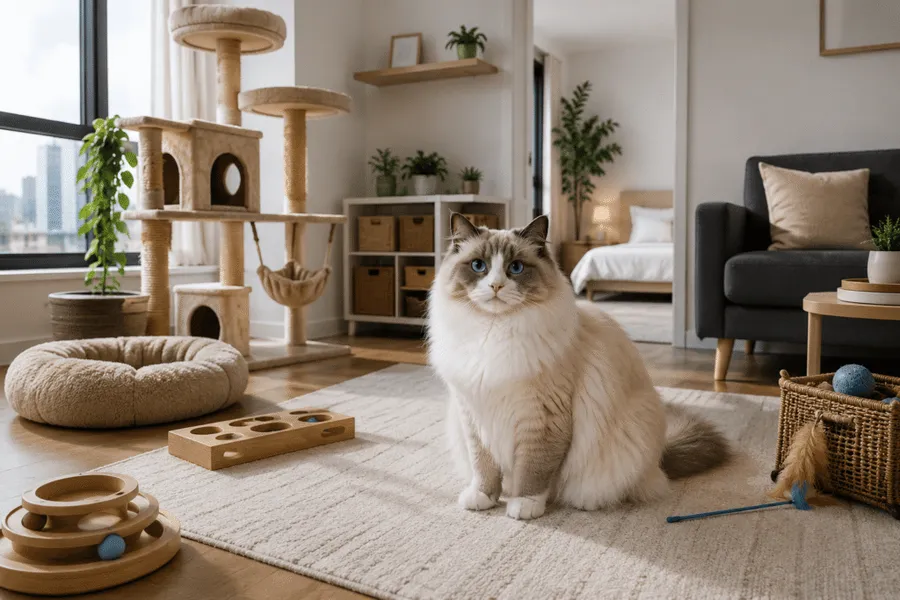
Ragdolls do not need a large home — they need a well-organized home. A small apartment of 400 to 600 square feet can fully meet a Ragdoll’s space requirements if it includes adequate vertical climbing space, appropriately sized cat furniture, a correctly sized litter box, daily interactive play, and consistent human presence. The Ragdoll’s calm, low-energy temperament makes them one of the most apartment-compatible large-breed cats available, provided their social and enrichment needs are met.
At a Glance: Ragdoll Space Requirements
| Requirement | Minimum | Ideal |
|---|---|---|
| Floor space | Any apartment size | 600+ sq ft |
| Vertical climbing space | 60-inch cat tree | 76-inch+ heavy-duty cat tree |
| Litter box size | Extra-large (30+ inch interior) | Self-cleaning, large-capacity |
| Resting space | Oversized cat bed | Multiple resting locations |
| Play space | Dedicated 6 x 6 ft area | Full room accessible |
| Social space | Owner present daily | Multi-person household |
| Outdoor access | Not required | Optional supervised access |
Do Ragdoll Cats Need a Lot of Space?
The question of space for a Ragdoll is frequently framed incorrectly. Many prospective owners assume that because Ragdolls are large cats, they need large homes. This assumption conflates physical size with behavioral need in a way that does not hold up when you examine how Ragdolls actually use space.
Ragdolls are low to moderate energy cats with a profoundly calm resting temperament. Unlike Bengal cats, Abyssinians, or Savannah cats — all of which have high-energy, exploration-focused personalities that genuinely benefit from large home footprints or outdoor access — Ragdolls spend the majority of their day in a relatively small number of preferred resting locations. They are not territory-pacing, room-roaming cats who need extensive space for behavioral expression.
What Ragdolls need is not square footage — it is quality of the space they do have. A Ragdoll in a 500-square-foot apartment with a 76-inch heavy-duty cat tree, an appropriately sized litter box, an enriched interactive play area, and a present, engaged owner is a deeply contented cat. The same Ragdoll in a 2,000-square-foot house where the owner is absent for 10 hours a day and the only furniture is a standard cat bed will be significantly less well-served despite the greater floor space.
The Most Important Space Element: Vertical Space

Vertical space is functionally more important than horizontal floor space for indoor cats of all breeds, and this is especially true for Ragdolls. The ability to climb, perch at height, and observe the home environment from elevated positions satisfies multiple behavioral needs simultaneously: the instinct to monitor territory from a safe elevated position, the need for physical exercise through climbing, and the preference for warm, elevated resting surfaces that most cats display.
A Ragdoll without adequate vertical space will often default to climbing onto human furniture — sofas, bookshelves, countertops — because the instinct to achieve height is present even without appropriate outlets for it. A well-chosen, appropriate-height, appropriate-weight-rated cat tree addresses this effectively and typically reduces unwanted furniture climbing.
For a breed that reaches 15 to 20 pounds at full maturity, the cat tree chosen for vertical space must be specifically rated for large cat weight and must have platforms and condos of sufficient size for the cat to use comfortably. The Catlike 76-Inch Rock-Solid Cat Tree is explicitly designed for large cats, including Maine Coons — with extra-large condos, extra-thick 2.7-inch reinforced posts, solid wood panels, and a reinforced base that remains stable under the jumping weight of a large adult Ragdoll. Its 8 to 12-inch level spacing creates natural climbing progression without requiring the leaps that can be awkward for a large, heavier cat.
Litter Box Space Requirements for Large Ragdolls

One of the most practically important space considerations for Ragdoll ownership is litter box placement and sizing. The standard rule of thumb — a litter box should be at least 1.5 times the cat’s body length in interior dimension — means that a 20-inch male Ragdoll requires a litter box with at least 30 inches of interior length. Most standard litter boxes measure 14 to 18 inches — far too small for a full-grown Ragdoll to turn around, position appropriately, and eliminate without overhang or discomfort.
An undersized litter box creates hygiene problems because a large cat cannot position properly within it, leading to elimination outside the box — not from behavioral issues but from simple physical inability to use the space provided. This is one of the most common preventable litter box problems in large-breed cat households and is remedied entirely by providing a box sized for the actual cat rather than the average cat.
For long-term convenience and effective odor management, the HHOLOVE Self Cleaning Litter Box with its large-capacity open-top drum design eliminates both the size constraint and the daily manual scooping requirement. The 60L capacity handles a single large Ragdoll for up to 7 days between emptying, and the real-time health monitoring through the companion app allows owners to track litter box usage patterns as a passive health monitoring tool.
Resting and Sleeping Space Requirements
Ragdolls are champion sleepers — consistent with the breed’s low energy temperament and the large amount of time all adult cats spend in rest. A full-grown Ragdoll sleeps between 12 and 16 hours per day, and the quality and appropriateness of their resting spaces significantly influence their comfort and well-being.
A standard cat bed at 20 inches in diameter will not comfortably accommodate a 20-pound male Ragdoll in any position other than an awkward compressed curl. Appropriately sized resting spaces — beds with 24 to 30-inch interior dimensions — allow the cat to stretch, roll, and reposition throughout their extended daily rest periods without being physically constrained.
Multiple resting locations throughout the home are more valuable than a single large bed. Ragdolls follow their owners and will seek proximity to wherever their person is at any given time — a resting option near the owner’s work area, another near the primary evening sitting location, and one in the bedroom if the cat is allowed access all meet the breed’s natural proximity-seeking behavior without requiring the owner to maintain a single designated “cat room” separate from the rest of the home.
Creating an Enriched Space for a Ragdoll
The quality of environmental enrichment within the available space matters more than the size of that space. For a Ragdoll in any sized home, a well-enriched environment includes at minimum: a tall, stable, large-cat-rated cat tree with multiple levels, at least one window with an accessible perch positioned to provide a view of outdoor activity, a selection of rotating interactive toys, a designated play area clear enough for the cat to move through wand toy play sessions, and a consistently placed food station with an appropriate-capacity automated feeder and fresh water fountain.
The Catstages Tower of Tracks 3-Tier provides excellent solo enrichment for the independent periods between owner-led play sessions, satisfying the batting and tracking instinct through multiple independently moving balls at different heights. It occupies minimal floor space while providing genuine engagement value.
For monitoring your Ragdoll’s use of their enriched space during working hours, the eufy Security Indoor Cam E220 2-Cam Kit provides 2K clarity with pet AI detection that tracks movement across each room — useful for confirming the cat is actively using the enrichment provided rather than showing signs of boredom or distress during daytime separation.
Do Ragdolls Need Outdoor Access?
No. Ragdolls are classified as indoor cats by both TICA and the CFA breed standards, and there are specific reasons why outdoor access is actually discouraged for this breed beyond the general safety concerns applicable to all domestic cats.
Ragdolls’ exceptionally trusting nature — the same quality that makes them such magnificent companions — makes them genuinely unsuitable for unmonitored outdoor access. They lack the wariness of strangers and the territorial defensiveness that help outdoor cats navigate risks from other animals, unfamiliar people, and traffic. A Ragdoll will approach an unfamiliar dog with the same calm trust it displays toward its owner, which is not the appropriate response to most uncontrolled dogs.
If outdoor exposure is important to you, supervised harness walks using an appropriately sized harness offer an excellent compromise that provides fresh air and novel environmental stimulation without the safety risks of unmonitored outdoor access. The best harness for Ragdoll cats guide covers appropriate harness options for the breed’s specific body proportions.
Can a Ragdoll Live in One Room?
A Ragdoll should not be confined to a single room under normal circumstances. While a single room might seem adequate from a floor-space perspective, room confinement that prevents the cat from following their owner through the home — a behavior that is neurologically rooted in the breed’s people-orientation — creates genuine distress in this breed. Ragdolls are not cats who live contentedly in isolation from their person.
The minimum appropriate living space for a Ragdoll is the room or rooms where the owner spends most of their time, providing the cat access to human proximity as needed throughout the day. In practice, most owners simply provide full-home access, which suits the Ragdoll’s personality perfectly — they will follow their person rather than dispersing widely through unused space.
What We Have Covered
This guide covered exactly what space a Ragdoll cat actually needs — establishing clearly that floor area matters less than space quality for this breed, explaining why vertical space through an appropriately sized and weight-rated cat tree is functionally more important than home square footage, addressing litter box sizing requirements that are frequently inadequate for the breed’s actual adult dimensions, covering resting space needs and how to provide multiple high-quality resting locations throughout any sized home, establishing that outdoor access is not appropriate or necessary for Ragdolls, and confirming that single-room confinement conflicts with the breed’s social nature.
A well-organized, enriched small apartment meets a Ragdoll’s genuine needs more completely than a large, barren house with no human presence and no age-appropriate cat furniture — the quality of the space matters far more than its size for this calm, people-oriented breed. For More information, reach out to our contact page.
Frequently Asked Questions
How much space does a Ragdoll cat need?
Ragdolls do not need a large floor area — they need quality within the space available. A 400 to 600 square foot apartment with appropriate vertical space, sized furniture, an enriched environment, and consistent owner presence fully meets a Ragdoll’s needs.
Can a Ragdoll cat live in a small apartment?
Yes. Ragdolls are low-energy, people-oriented cats who thrive in small spaces if those spaces are enriched with appropriate cat furniture, interactive play opportunities, and consistent human company.
Do Ragdolls need outdoor access?
No. Ragdolls are indoor cats whose trusting nature makes unmonitored outdoor access a safety risk. Supervised harness walks can provide outdoor enrichment safely.
Do Ragdolls need a lot of vertical space?
Yes, more than horizontal floor space. A tall, heavy-duty cat tree rated for large cats is the single most important space enrichment investment for any Ragdoll home.
What size litter box does a Ragdoll need?
At minimum, an interior litter area of 30 inches in length — 1.5 times the cat’s 20-inch body length — is appropriate. Most standard litter boxes are significantly undersized for adult Ragdolls.
Can a Ragdoll live in one room?
Not comfortably. Ragdolls are deeply people-oriented and need access to their owner rather than confinement to a specific room. Full-home access with appropriate cat furniture throughout is the ideal arrangement.

Hi, I’m Mark Allen. I specialize in researching and writing about Ragdoll cats, covering topics such as behavior, grooming, nutrition, health, and breed characteristics. My goal is to provide cat owners with practical, well-researched information that helps them make informed decisions and better care for their pets.

