
Why Are Ragdoll Cats So Large? Genetics, Breeding, and the Science Behind Their Size
Quick Answer
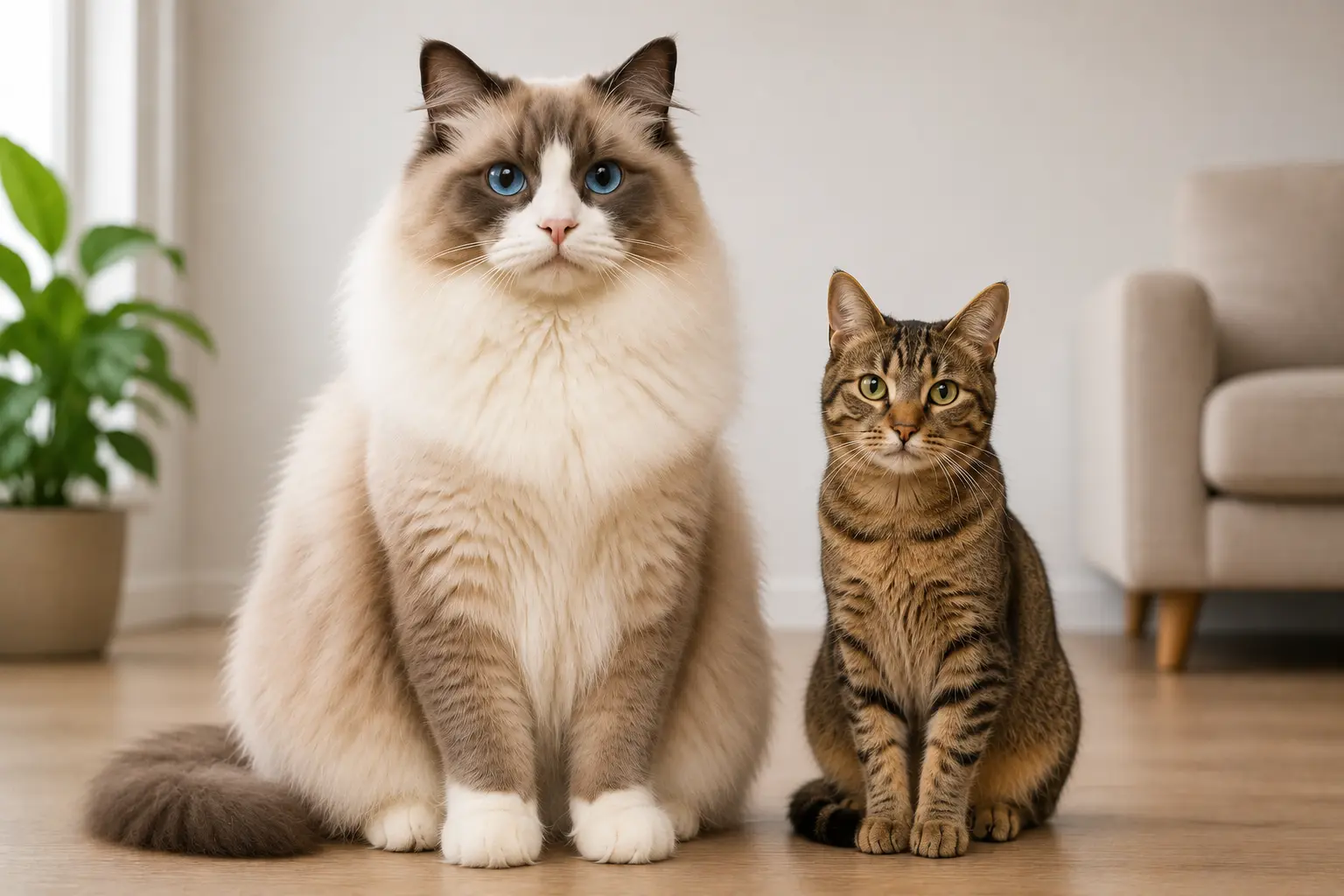
Ragdoll cats are so large because they were selectively bred from the beginning for exceptional size, with founder breeder Ann Baker consistently choosing the largest individuals in her breeding program during the 1960s. The breed’s size is further supported by a heavy bone structure, large muscle mass relative to body length, and an unusually slow maturation timeline of 3 to 4 years that allows an extended period of skeletal and muscular development unavailable to faster-maturing breeds.
At a Glance: What Makes Ragdolls So Big
| Factor | How It Contributes to Size |
|---|---|
| Selective breeding history | Size was a primary selection criterion from the breed’s origin |
| Heavy bone density | Ragdolls have denser, heavier skeletal structure than average |
| Large muscle mass | Broad-chested, well-muscled body adds weight beyond frame size alone |
| Extended maturation | 3 to 4 year growth timeline allows more development than most breeds |
| Body proportions | Long body, substantial limbs, and heavy-boned large head compound weight |
| Semi-long coat volume | Adds to the visual impression of even greater size |
The History Behind Ragdoll Size: Why Were They Bred This Way?
The Ragdoll was developed in Riverside, California, during the 1960s by a breeder named Ann Baker. The foundational breeding program began with a white long-haired domestic cat named Josephine and selected the offspring that displayed specific desirable characteristics — deep calm, extreme trust, affectionate social behavior, and notably, large body size. Baker viewed size as an intrinsic part of the Ragdoll’s distinctive identity and deliberately bred for it across generations.
This selective pressure for size created a positive feedback loop over multiple generations. The largest cats were most likely to produce large offspring, those offspring were most likely to be selected for breeding, and their offspring were again assessed for size alongside the behavioral qualities that defined the breed. Over several decades of this intentional selection, the Ragdoll population drifted significantly upward in average body weight relative to the general domestic cat population.
By the time TICA recognized the Ragdoll as a distinct breed in 1979 and the CFA in 2000, the size range documented in the official TICA breed standard already reflected a breed that had been consistently producing cats in the 15 to 20 pound male range for decades through this concentrated selective breeding history.
Ragdoll Cat Body Structure: Why Heavy Bones Matter

Ragdoll size is not primarily a function of excess fat or even exceptional muscle — it reflects a genuinely heavier skeletal framework than most domestic cat breeds carry. Bone density and thickness vary significantly between cat breeds, and the Ragdoll sits at the heavy end of the domestic cat spectrum in this regard.
When a veterinarian radiographs a Ragdoll alongside an average domestic cat of similar apparent size, the difference in bone thickness, density, and overall skeletal mass is visible and meaningful. This heavier skeletal baseline means that a Ragdoll in excellent lean condition — a cat at ideal body weight with good muscle tone and no excess fat — will still weigh considerably more than a same-length domestic cat in equally good condition, simply because the underlying bone structure is heavier.
This explains one of the most consistent observations among first-time Ragdoll owners: the surprise at picking up the cat. A Ragdoll that looks similar in length and apparent size to a large domestic cat will feel significantly heavier when lifted, because the bone mass contributing to that weight is greater than the coat volume alone would suggest.
The broad, deep chest characteristic of Ragdolls — another feature selected for during the breed’s development — further compounds weight by providing a larger thoracic cavity and the associated broader rib cage and supporting musculature that the chest demands.
The Extended Maturation Timeline: Why Ragdolls Keep Growing
Most domestic cat breeds reach their full adult size between 12 and 18 months of age. A British Shorthair, a Siamese, a domestic shorthair — all of these cats are essentially as large as they are going to get by their first birthday or shortly after. This compact growth timeline limits the total size these breeds can achieve because skeletal and muscular development stops relatively early.
Ragdolls are fundamentally different. Males typically do not reach full adult size until 3 to 4 years of age. Females mature somewhat faster at 2 to 3 years. This extended growth timeline — roughly double the length of most domestic cat maturation periods — allows the Ragdoll to continue adding bone density, muscle mass, and body width across a period when other breeds have long since stopped growing.
The practical implication of this extended growth window is significant. A male Ragdoll who weighs 12 pounds at 12 months is not close to his final size — he may add another 4 to 8 pounds over the following 2 to 3 years. This surprises many owners who expect cat growth to follow the typical 12-month arc they are familiar with from other breeds or from domestic cats. Understanding this timeline is essential for managing expectations, nutrition during growth phases, and equipment choices that will need to accommodate a significantly larger adult cat than the one-year-old suggests.
Are Ragdolls Genetically Large?
Yes, in the specific technical sense that their large size reflects a stable genetic trait selected across many generations of deliberate breeding rather than environmental factors, dietary excess, or coincidental variation. The genetics of feline body size involves multiple gene loci influencing bone density, growth hormone receptor sensitivity, muscle fiber development, and the timing of growth plate closure — and Ragdolls have, through decades of size-focused selection, developed an allele distribution across these loci that consistently produces large body size.
This genetic stability means that Ragdoll size is highly heritable. A litter from two large Ragdoll parents will reliably produce large kittens that grow into large adults, regardless of whether those kittens are fed more or less generously than average. Nutrition influences whether a cat reaches its genetic potential — underfed Ragdoll kittens will be smaller than their genes would produce under optimal conditions — but cannot push a Ragdoll above its genetic ceiling or reduce it below its genetic floor under normal circumstances.
Why Ragdolls Are Larger Than Most Other Breeds: The Comparison
Understanding Ragdoll size in context requires comparing it to other breeds that are also considered large.
| Breed | Average Adult Male Weight | Notes |
|---|---|---|
| Ragdoll | 15 to 20 lbs | Extended 3 to 4 year maturation, heavy bone |
| Maine Coon | 13 to 18 lbs | Comparable — longer body, slightly lighter on average |
| Siberian | 12 to 17 lbs | Dense coat creates a larger visual impression than the weight reflects |
| Norwegian Forest Cat | 12 to 16 lbs | Similar coat volume, lighter build |
| British Shorthair | 9 to 17 lbs | Wide range — heavier individuals comparable to Ragdoll |
| Persian | 9 to 14 lbs | Significantly lighter despite large visual impression from coat |
| Siamese | 8 to 12 lbs | Lean, fine-boned — among lightest pedigree breeds |
| Average Domestic Cat | 8 to 10 lbs | Reference for the general population |
Ragdoll vs Maine Coon Size
This is the comparison that generates the most debate among large-breed cat enthusiasts. In terms of average adult male weight, the Ragdoll and Maine Coon are genuinely comparable — both produce males in the 15 to 20 pound range regularly. Maine Coons tend to be somewhat longer in body relative to their weight, while Ragdolls tend to be heavier in a more compact frame. Neither breed has an unambiguous size advantage over the other at the population level, and the largest individuals of each breed fall in approximately the same weight range.
Ragdoll vs Persian Size
The Persian is often visually confused with a large cat because of its voluminous, high-maintenance coat that significantly inflates apparent size. In actual body weight, Persians are substantially lighter than Ragdolls — adult males typically fall in the 9 to 14 pound range compared to the Ragdoll’s 15 to 20 pounds. This is one of the clearest examples of how coat volume can create a misleading visual impression of size relative to actual weight.
Why Do Ragdolls Weigh So Much?
The combination of heavy bone density, large muscle mass from a broad chest and well-developed hindquarters, and an extended growth timeline adds up to a total body weight that consistently exceeds what owners expect from cats of the Ragdoll’s apparent visual size. A Ragdoll does not look twice as heavy as a domestic cat — the proportions and coat texture create an impression of an impressive but not dramatically larger animal — yet the scale frequently reveals a weight differential of 50 to 100 percent compared to an average domestic cat in similar apparent condition.
The semi-long, single-layer coat also contributes to the visual impression of size without contributing meaningfully to actual weight. The flowing, silky coat adds visual volume but weighs very little. When a Ragdoll is wet from a bath, the coat loses most of its visual volume, and the cat’s true body proportions become clear — typically a surprise to owners seeing their cat without the coat’s contribution to the visual impression for the first time.
Can Ragdolls Become Overweight?
Yes, and this is a genuine health risk for the breed. The same calm, low-activity indoor temperament that makes Ragdolls such appealing companion animals also creates conditions that support weight gain if caloric intake is not managed. A Ragdoll who spends most of the day sleeping on a warm bed, eating freely from a bowl, and engaging in limited active play will gain weight on a caloric intake that would maintain a more active cat at a healthy body weight.
Obesity in Ragdolls creates joint stress on the already-heavy skeletal structure, increases cardiac workload, and compounds any inherited predisposition to hypertrophic cardiomyopathy. Managing weight through appropriate portion control and daily active play is, therefore, both a quality-of-life concern and a genuine preventive health measure for this breed.
A practical weight management tool for Ragdoll owners is the PETLIBRO RFID Automatic Cat Feeder, which activates only for the microchipped cat it recognizes — preventing food theft between cats in multi-cat households and ensuring the portioned amount is consumed by the correct cat without overfeeding.
Are Ragdolls Considered Giant Cats?
No. The term “giant cat” in domestic cat contexts typically refers to Savannah cats of the upper filial generations (F1 and F2), which can reach 25 to 30 pounds, or to extraordinarily large individuals of any breed that fall significantly outside the typical range. Ragdolls are classified as large rather than giant, which in the CFA and TICA grading systems reflects a weight range of roughly 10 to 20 pounds for adults rather than the 20+ pound range where “giant” might more accurately apply.
That said, the largest verified Ragdolls documented by owners fall in the 22 to 25 pound range, blurring the practical distinction between “large” and “giant” for individuals at the extreme upper end of the breed’s genetic expression. These extraordinary individuals represent the outer edge of what Ragdoll genetics can produce rather than the typical expectation.
What We Have Covered
This guide explained why Ragdoll cats are so large through four converging factors: the deliberate selection for large size during Ann Baker’s foundational breeding program in the 1960s, the heavy bone density that distinguishes Ragdolls from breeds of similar apparent visual size, the unusually extended maturation timeline of 3 to 4 years that gives Ragdolls far longer to develop than most domestic cat breeds, and the large muscle mass associated with the breed’s broad chest and substantial body structure. We compared Ragdoll size against other large domestic cat breeds, addressed the obesity risk that the breed’s calm temperament creates, and clarified the distinction between large and giant as applied to domestic cats.
The size of a Ragdoll is one of its most defining and most appealing characteristics — and understanding why they are so large makes it far easier to plan for that size practically, from equipment purchases to nutrition management to veterinary monitoring. For More information, reach out to our contact page.
Frequently Asked Questions
Why are Ragdoll cats so big?
Ragdolls were deliberately bred for large size from their origin in the 1960s. This intentional selection created a breed with heavy bone density, large muscle mass, and an extended 3 to 4 year growth timeline that produces consistently large adults.
Do all Ragdolls get big?
Yes, all healthy Ragdolls grow to a large size relative to the domestic cat average. Individual variation exists — some Ragdolls from smaller-framed parent lines may mature in the lower ranges — but even the smallest typical Ragdolls significantly outweigh the average domestic cat.
Are Ragdolls one of the largest cat breeds?
Yes. Ragdolls are consistently ranked among the top two or three heaviest domestic cat breeds by average adult male weight, alongside the Maine Coon and Siberian. They are the breed most likely to produce adult males exceeding 18 pounds through standard breeding programs.
Why do Ragdolls take longer to mature than other cats?
The extended maturation timeline of Ragdolls is a breed characteristic rather than a health concern. It reflects the breed’s genetic programming for gradual, sustained development that produces greater final body mass than the faster maturation of smaller breeds allows.
Are Ragdolls bigger than Maine Coons?
In terms of average adult male weight, Ragdolls and Maine Coons are closely comparable. Maine Coons tend to be somewhat longer in body, while Ragdolls tend to be heavier in a more compact frame. Neither has a clear, consistent size advantage at the population level.
How large can a Ragdoll cat get?
Within the typical breed range, male Ragdolls reach up to 20 pounds at healthy body condition. The largest verified individuals fall in the 22 to 25 pound range. Any weight above 22 pounds warrants a body condition assessment to confirm it reflects muscle and bone rather than excess fat.

Hi, I’m Mark Allen. I specialize in researching and writing about Ragdoll cats, covering topics such as behavior, grooming, nutrition, health, and breed characteristics. My goal is to provide cat owners with practical, well-researched information that helps them make informed decisions and better care for their pets.

