Ragdoll Cat Matting: Why It Happens and How to Remove Mats Safely

Quick Answer
Ragdoll cat matting happens when shed hairs tangle in the silky single-layer coat, behind the ears, under the armpits, or on the belly. Brush 2–3 times a week to prevent mats. To remove one, tease it apart with your fingers, then a wide-tooth comb, working from the edge inward — never cut a mat with scissors near the skin.
If you have ever run your hand down your Ragdoll’s side and felt a hard little knot hiding in all that soft fur, you know the sinking feeling. Ragdolls are famous for their silky, low-maintenance coats — so why do Ragdoll cats get matted at all?
The very thing that makes a Ragdoll coat so lovely is also what makes it tangle: fine, silky, rabbit-soft hair knots around itself far more easily than coarse hair does. Add friction from a collar, a scratch behind the ear, or a week without brushing, and a small tangle tightens into a mat.
The good news is that ragdoll cat matting is almost always preventable, and most mats can be removed safely at home if you catch them early and work patiently. This guide covers why Ragdolls mat, where mats hide, how to remove mats from a Ragdoll cat step by step, the tools that actually help, and when a mat is a job for a groomer or a vet — not you.
Why Do Ragdoll Cats Get Matted?
Ragdolls have a semi-long, silky, single-layer coat with almost no undercoat. That is the first thing to understand about ragdoll cat matting, because it surprises most owners. Long-haired breeds like Persians and Maine Coons mat because a thick, woolly undercoat traps shed hair against the skin. Ragdolls do not have that thick undercoat — and they still mat.
Here is what happens instead. A Ragdoll sheds loose guard hairs every day. If those hairs are not brushed away, they stay in the coat, and the fine silky strands wrap around each other. Every time your cat moves, scratches, or rolls, the tangle twists a little tighter. Static electricity makes it worse, especially in dry indoor air, and so does any moisture — a damp patch of fur clumps and sets harder as it dries. Dander, skin oils, and a bit of dust get caught in the knot, and within days a tangle you could have combed out has become a dense, felted mat that pulls on the skin underneath.
So the paradox of the Ragdoll coat is real: less undercoat means less shedding and fewer giant mats than a Persian — but the silky texture means the tangles that do form tighten fast if they are ignored. Even a diligently groomed Ragdoll can develop a mat. The goal is not perfection. It is catching tangles while they are still small, soft, and painless to remove.
Shedding season makes matting worse
Ragdolls shed more heavily in spring and autumn as their coat adjusts to changing daylight and temperature. Spring is the bigger of the two: the denser winter coat comes out, and loose fur is everywhere. If you brush at the same 2–3 times a week pace through a spring shed, loose hair builds up faster than you remove it — and that is when mats appear. During shedding season, brush every day or every other day. It takes five minutes, and it is the single most effective thing you can do to prevent matting in a Ragdoll. For the full picture of what is normal, see Do Ragdoll Cats Shed? and How to Reduce Ragdoll Cat Shedding.
Age, weight, and health change the risk
Mats are not always about brushing. Senior Ragdolls groom less thoroughly — arthritis makes twisting to reach the back and hindquarters painful — and overweight cats cannot reach their own backs either. A cat that suddenly stops grooming, or suddenly starts matting when they never did before, may be in pain or unwell. If your Ragdoll’s coat condition changes fast, that is a vet visit, not a grooming problem. See Ragdoll Cat Lifespan and Common Ragdoll Health Problems for what to watch for as your cat ages.
Ragdoll Matted Fur Behind Ears and Other Friction Points
Mats form where fur rubs. On a Ragdoll there are five places to check every time you brush — learn them and you will find most mats while they are still small enough to tease out with your fingers.

- Behind the ears. The number one spot for ragdoll matted fur behind ears. Every scratch, head shake, and ear rub twists the fine hair behind the ear into knots, and the skin there is thin, so a mat behind the ear hurts quickly. Check behind both ears at every session — part the fur with your fingers and look, because a mat can hide under smooth-looking top hair.
- Under the armpits. Every step your Ragdoll takes rubs the fur under the front legs together. Armpit mats are the most painful kind, because the skin is thin and the mat gets pulled with every movement. Lift each front leg gently and check the hollow underneath.
- Around the collar. If your Ragdoll wears a collar — or a harness on walks — the constant rubbing against the neck fur creates tangles exactly where the collar sits. Take the collar off for brushing, check the full circle of the neck, and consider whether your cat needs the collar indoors at all. If you walk your Ragdoll, our Can Ragdoll Cats Go for Walks? guide covers harness fit.
- On the belly. Belly fur is long, soft, and constantly rubbed by bedding, furniture, and your cat’s own legs when they curl up. It is also the spot most cats least enjoy having touched, so it gets skipped — and that is exactly why belly mats get big before anyone notices. Check the belly while your cat is lying on their side, one gentle stroke at a time.
- The back legs and britches. The long, fluffy fur on a Ragdoll’s hind legs — often called the britches — is a magnet for mats, and so is the fur around the rear and inner thighs. These areas collect litter dust and debris, they rub together when your cat walks, and they are hard for the cat to groom properly. Check them last, when your cat is calmest.
To find hidden mats, run a wide-tooth comb slowly through the whole coat after brushing. If it glides through, the coat is clear; if it snags, you have found a tangle. Do this weekly even if the coat looks fine — many mats start underneath, where you cannot see them.
Are Ragdoll Cat Mats Painful?
Yes. A small, loose tangle is not painful, but as a mat tightens it pulls constantly on the skin underneath — every step, stretch, and jump tugs at it. The skin under a tight mat gets sore and red, and because a mat traps moisture and blocks airflow, the area underneath can develop hot spots and skin infections you cannot see until the mat is removed. In severe cases a whole section of coat felts into a single solid sheet, called pelting, that restricts movement and has to be shaved off by a professional.
Mats also hide things: a lump you assume is a mat can be a wound or a sore underneath. And a Ragdoll with mats grooms around them and swallows more loose hair, which means more hairballs — if those are a regular problem, read Hairballs in Ragdoll Cats and treat the mats and the brushing routine as the first fix.
How to Remove Mats From a Ragdoll Cat Safely
Dematting a Ragdoll cat is a patience job, not a strength job. The whole method is slow, gentle, and in small stages — and if your cat gets stressed, you stop and try again tomorrow. A mat that took a week to form does not need to come out in one sitting.
Set yourself up first. Pick a time when your Ragdoll is already relaxed — after a meal, after play, or during a lap cuddle. Put your tools where you can reach them without getting up: your fingers, a wide-tooth steel comb, and a dematting rake for stubborn spots. Keep treats nearby. And keep the fur dry — adding water to a mat makes it set even tighter, so never wet a mat to work it out. A detangling spray made for cats can help, but use only products made for cats, never human detangler or baby oil, which can contain ingredients that are not safe for cats.

Step 1: Find the mat and hold the base
Part the fur and find the edges of the mat. Before you pull or comb anything, hold the fur closest to the skin with your fingers, between the mat and the skin. This is the most important habit in dematting: holding the base stops the pulling from reaching the skin, so your cat feels almost nothing while you work on the mat itself. If you skip this, every tug pulls the skin — and that is when cats bite, scratch, and learn to fear grooming.
Step 2: Work it with your fingers first
Start with your fingers, not a tool. Gently pull the mat apart from the outer edge, teasing a few hairs loose at a time and working inward. Most small, fresh mats come apart this way in a minute or two — fingers can feel when a strand is ready to come free.
Step 3: Use a wide-tooth comb, ends first
If fingers alone are not enough, switch to a wide-tooth steel comb. Hold the base with one hand and pick at the outer end of the mat with the end teeth of the comb, a few hairs at a time, working inward. Never drag the comb through the middle of a mat, and never yank — a yank tears hair out by the root and hurts. If the comb snags, go back to your fingers, then try again on a smaller section.
Step 4: Use a dematting rake only on a real mat
For a dense mat that the comb cannot get through, a dematting rake is the right tool — this is what the Maxpower rake in our product picks below is for. Use it the same way: hold the base, work from the outer edge inward, short gentle strokes, and let the teeth do the work instead of pressing hard. A rake is for mats, not for daily brushing. On a Ragdoll’s silky single coat, a rake used as a daily brush is too much — it will thin and break the topcoat. Use the rake on the mat, then put it away and finish with the comb and a slicker.
Step 5: Know when to stop
Stop if your cat cries, hisses, tries to bite, or goes rigid. Stop if the skin under the mat is red, broken, oozing, or smells bad. Stop if the mat is flat against the skin and you cannot get a finger underneath it — that mat is too tight to remove at home. In all of those cases, the right move is a groomer or a vet, not one more try. You can always come back to a mat tomorrow; you cannot undo a cut or a frightened cat.
What about cutting a mat out?
Cutting is the last resort, and scissors against the skin should never be the tool. Cat skin is thin and it tents up into a mat — the skin gets pulled up inside the knot, so what looks like pure fur from the outside has skin hidden in it. That is how well-meaning owners end up at the emergency vet with a cat that needs stitches. Veterinarians who write about mat removal say the same thing every time: taking scissors to a mat close to the skin is never a good idea.
If you must cut, only do it when the mat is loose, well away from the skin, and you can slide a comb flat between the mat and the skin as a guard — then cut above the comb, never below it. For most owners the safer rule is simpler: if fingers and a comb cannot get it out, let a groomer do it with clippers. A groomer slides a clipper blade flat under the mat and the mat comes off in one piece — a ten-minute job, and a much kinder one for your cat.
What NOT to Do When Dematting a Ragdoll Cat
- Do not use scissors close to the skin. Cat skin tents up into mats and is very easy to cut. If you cannot slide a comb between the mat and the skin, do not cut.
- Do not wet the mat. Water makes a mat set tighter, not looser.
- Do not yank or drag a brush through a mat. Yanking tears hair out, hurts, and teaches your cat to fear grooming.
- Do not use a deshedding blade or a rake as your daily brush. They are mat tools — used daily on a Ragdoll’s silky coat, they thin and break the topcoat. See Best Brushes for Ragdoll Cats for the safe daily tools.
- Do not use human hair products. Human detanglers, baby oil, and coconut oil can contain ingredients that are not safe for cats. Use only cat-safe products.
- Do not hold your cat down and force it. Short, calm sessions with treats beat one long battle every time.
- Do not ignore a mat. A small tangle today is a tight, painful mat next week — check the friction points at every session.
The 3 Best Tools for Ragdoll Cat Matting
The best brush for Ragdoll cat matting depends on the job. A mat that already exists needs a dematting tool. A coat that keeps tangling needs a gentle daily tool. And a cat that hates being brushed needs the gentlest option of all. These three cover all three jobs, and each one was checked against a real Ragdoll coat: silky, single-layer, and easy to damage with a tool that is too harsh.
One honest note before the picks: a dematting rake is a mat tool, not a daily brush. The Maxpower rake below is our top pick for removing mats, and it is excellent at that job — but do not use it as your everyday brush. For daily brushing, use a slicker or the TUFFYUKI, and keep the rake for the mats.
Maxpower Planet Dog Grooming Rake — Best Dematting Tool for Ragdoll Cats
$11.30 (was $19.99 — Black Friday, 43% off)
Type: Double-sided undercoat rake, Extra Wide | Teeth: 9-tooth dematting side + 17-tooth deshedding side | Rating: 4.6 stars (60,416 ratings) | Badge: Amazon’s Choice | Bought: 10K+ in the past month

The Maxpower Planet rake is the best dematting tool for Ragdoll cats in this guide, because it is built for exactly the job a mat needs: two different tooth spacings on one tool. The 9-tooth side works through dense tangles and mats, and the 17-tooth side thins out loose undercoat and desheds — so you start on the wide-spaced side for the mat itself, then finish with the closer side to smooth the coat. The Extra Wide head covers a big section in one pass, which matters on a large cat like a Ragdoll, and the rounded teeth are designed to glide through fur without scratching the skin underneath.
The honest cautions: $11.30 is the Black Friday price, down from $19.99, so re-check the price before you buy — it may rise when the promotion ends. And do not use this rake as your everyday brush. On a Ragdoll’s silky single coat, a rake used daily will thin and break the topcoat. Use it on mats, then put it away and finish with a comb and a slicker.
Benefits
- Two tooth spacings — 9-tooth for mats, 17-tooth for deshedding
- Extra Wide head covers more coat per pass
- Rounded teeth glide without scratching skin
- 4.6 stars from 60,416 ratings
- Amazon’s Choice, 10K+ bought in the past month
- $11.30 Black Friday price
Pain Points It Solves
- Dense mats a comb cannot get through
- Loose undercoat building up into new tangles
- One tool for both dematting and deshedding
- Large Ragdoll coat taking too long to work through
- Scratching thin skin under a mat
Best for: Any Ragdoll owner dealing with real mats — the most proven dematting tool here, at the lowest price in this guide.
Check Price on Amazon — $11.30 →Price $11.30 Black Friday (was $19.99), checked Nov 22, 2026 from the live Amazon listing. Re-check on publish day.
TUFFYUKI Cat Brush for Shedding — Best Deshedding Tool for Ragdoll Cat Matting
$12.79 (was $15.99 — Black Friday, 20% off)
Type: Deshedding tool with curved stainless steel blade | Teeth: V-shaped teeth, Large size, White | Rating: 4.5 stars (20 ratings) | Badge: Amazon’s Choice | Bought: 50+ in the past month

The TUFFYUKI is the daily deshedding tool in this guide — the one that stops mats forming in the first place. Its curved stainless steel blade with V-shaped teeth is shaped to follow the curve of a cat’s body, so it reaches into the coat and lifts out loose shed hair before that hair can tangle into a mat. The large size covers a Ragdoll’s broad back and sides quickly, and the white handle is easy to hold for a full five-to-ten-minute session. At $12.79 on Black Friday, it sits in the same price range as the other daily brushes we recommend for this breed.
An honest note on the rating: the TUFFYUKI has 4.5 stars, but from only 20 ratings, so it is a newer and less proven option than the Maxpower rake with its 60,000-plus ratings. The early reviews are positive and it carries Amazon’s Choice, but treat it as a promising pick rather than a proven one. If you prefer a tool with thousands of reviews, the Maxpower rake above is the safer bet — and if you buy the TUFFYUKI, use it gently: a steel deshedding blade is stronger than a slicker, so light strokes and a light hand are essential on a Ragdoll’s silky coat.
Benefits
- Curved blade follows the cat’s body shape
- V-shaped teeth lift loose hair before it tangles
- Large size covers a Ragdoll’s coat quickly
- 4.5 stars, Amazon’s Choice
- $12.79 Black Friday price
Pain Points It Solves
- Loose shed hair building up into tangles
- Friction spots matting between brushings
- Needing a daily tool that is faster than a comb
- Shedding season loose fur all over the house
Best for: Owners who want a daily deshedding tool to prevent mats — a newer option with strong early reviews, used gently.
Check Price on Amazon — $12.79 →Price $12.79 Black Friday (was $15.99), checked Nov 22, 2026 from the live Amazon listing. Re-check on publish day. Rating is from 20 reviews — a small sample.
WOWOOF 5-in-1 Cat Hair Brush and Grooming Rakes — Best Steam Brush for Ragdoll Cat Matting
$9.99 (checked Nov 22, 2026 — re-check on publish day)
Type: 5-in-1 steam comb and grooming rake | Features: Fine mist spray, USB rechargeable | Rating: 4.0 stars (138 ratings) | Use: Cats, dogs, kittens, rabbits

The WOWOOF 5-in-1 is the gentlest way into a dematting routine for a Ragdoll that hates being brushed. It combines a steam comb with grooming rakes in one tool: the fine mist settles static electricity and lightly dampens the coat as you brush, which loosens tangles and keeps loose hair on the brush instead of floating into the air. Static is one of the quiet causes of ragdoll cat matting — fine silky hair builds up a charge and clings to itself — so a tool that removes static while it brushes is doing two jobs at once. The mist is room-temperature, not hot steam, and the tool is USB rechargeable.
The honest cautions: the rating is 4.0 stars from 138 reviews, the lowest here — solid, but not outstanding. And a steam brush is a finishing and maintenance tool, not a mat remover: if your Ragdoll already has a dense mat, work it out with your fingers, a comb, and the Maxpower rake first, then use the WOWOOF to keep the coat tangle-free afterwards. Do not add essential oils to the water tank — many are not safe for cats. Plain water only.
Benefits
- Fine mist settles static that causes tangles
- Loose hair stays on the brush, not in the air
- 5-in-1 — steam comb plus grooming rakes
- USB rechargeable
- $9.99 — cheapest pick here
Pain Points It Solves
- Cat hates dry brushing — mist makes it comfortable
- Static making silky fur cling and tangle
- Loose hair floating around the room
- Small tangles forming between full brushings
Best for: Ragdolls that hate dry brushing, and owners who want the cheapest way to add steam brushing to their routine.
Check Price on Amazon — $9.99 →Price $9.99 checked Nov 22, 2026 from the live Amazon listing. Re-check on publish day.
How to Prevent Matting in Ragdoll Cats
Removing a mat is damage control. Preventing one is the real goal — and prevention is a routine, not a product. A Ragdoll that is brushed the right way, at the right frequency, almost never develops a serious mat. Here is the routine that works.
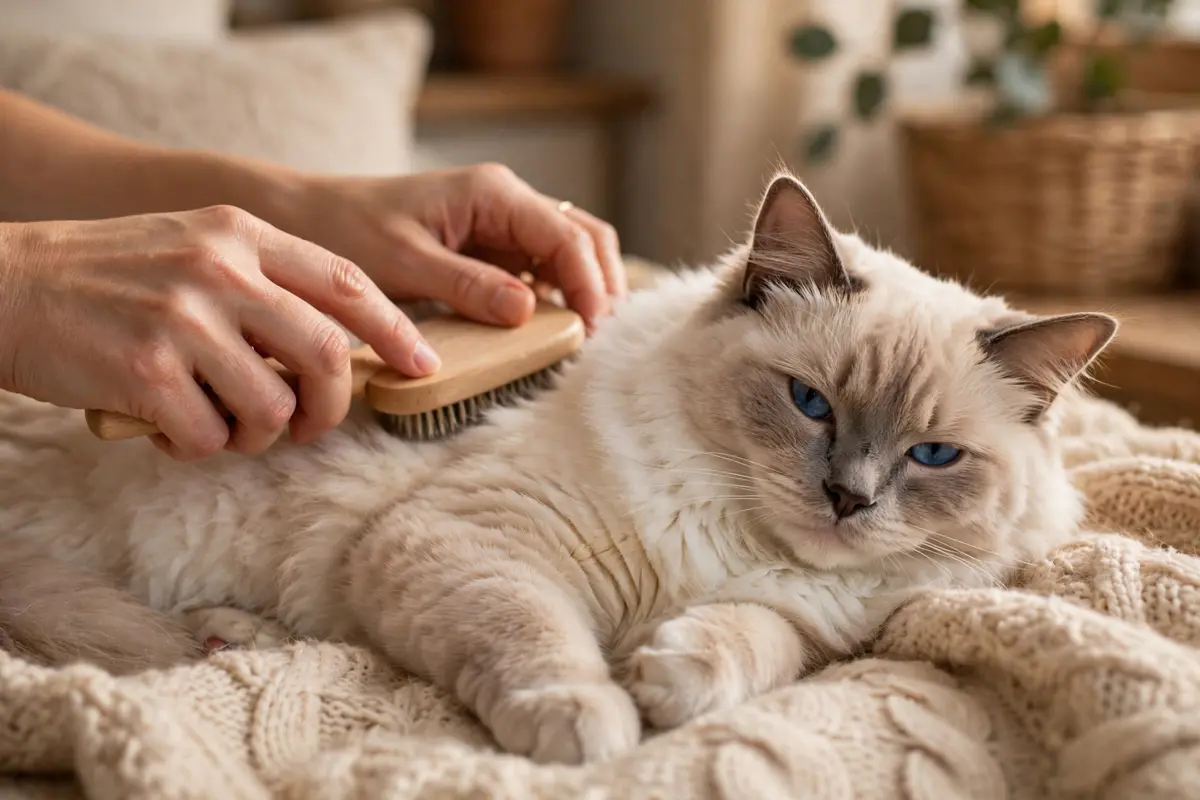
!A person’s hands brushing a relaxed Ragdoll cat lying on a soft blanket at home
Brush 2–3 times a week, daily in shedding season
Two to three times a week is the minimum for most adult Ragdolls. During spring and autumn shedding, brush every day or every other day. A session takes five to ten minutes: comb through first with a wide-tooth steel comb to find tangles, then finish with a slicker or a deshedding tool like the TUFFYUKI above. Stop while your cat is still happy — a Ragdoll that enjoys brushing will come to you when they see the brush, and that is worth more than any tool.
Kittens need shorter, gentler sessions — a minute or two with a soft slicker is enough while they learn that brushing is a good thing. Our Ragdoll Kitten First-Year Guide covers how to build that habit from the start. Senior Ragdolls need the same frequency but a lighter touch, especially on the belly and hips, where joints may be sore.
Do the friction spots first, every time
Behind the ears, under the front legs, around the collar, and on the belly — do these four spots first, while your cat is still calm, with the lightest touch. A minute on these spots prevents the mat that would take twenty minutes and a groomer visit to fix. If your cat will not let you near their belly, do it while they are lying on their side, one stroke at a time, and reward every stroke.
Keep the coat clean and dry
A clean coat brushes out far more easily than a greasy one, and a bath every few months is enough for most Ragdolls. See Do Ragdoll Cats Need Baths?, How to Bathe a Ragdoll Cat, and Best Shampoo for Ragdoll Cats. Always dry your Ragdoll fully after a bath — damp fur left to dry on its own clumps and mats.
Feed the coat from the inside
A Ragdoll eating well grows a stronger coat that sheds less and tangles less — a dull, dry coat that mats easily can be a sign the diet needs attention. See Best Cat Food for Ragdoll Cats and the Ragdoll Diet and Feeding Guide. For life-stage care through the senior years, our Ragdoll Health and Longevity Handbook covers coat, weight, and vet care in one place.
Make it a habit, not a chore
The owners who never deal with mats are not the ones with the most expensive tools — they are the ones with a routine. Same days, same time, same spot, same treat at the end. Keep the brush where you can see it. And if you want company while you build the habit, the Ragdoll Owners Club is a community of Ragdoll owners sharing grooming tips and what actually works on their own cats.
When to See a Vet or Groomer for Matted Ragdoll Fur
Most mats are a home job. These are not.
- The mat is tight to the skin. If you cannot slide a finger — or a comb — between the mat and the skin, do not try to remove it yourself. A groomer or vet will clip it out safely.
- The skin underneath is red, broken, oozing, or smells bad. That is a skin infection, not a grooming problem, and it needs a vet.
- Your cat cries, bites, or goes rigid when you touch the mat. Pain means stop. A professional can often remove a painful mat under sedation, which is far kinder than a fight at home.
- The whole coat is pelted. If large sections have felted into a solid sheet, the coat needs to be shaved by a professional. Do not try to cut it out yourself.
- Mats appeared suddenly in a well-groomed cat. A fast change in coat condition can be the first sign of illness, pain, or dental problems that stop a cat grooming properly. Book a vet visit and mention the coat change. See How Often Should a Ragdoll Cat See the Vet? for check-up timing, and Ragdoll Kitten First Vet Visit for what a first visit looks like.
- Your cat is senior, overweight, or arthritic and cannot groom. A regular professional groom every few months, on top of your home brushing, keeps these cats comfortable. Ask your vet for a groomer recommendation — a groomer who knows cats, not just dogs, is worth finding.
This article is general information about Ragdoll coat care, not veterinary advice. If you are worried about your cat’s skin, coat, or health, please speak to your veterinarian.
Ragdoll Cat Matting — Frequently Asked Questions
Why do Ragdoll cats get matted?
Ragdoll cats get matted because their fine, silky, single-layer coat tangles easily. Loose shed hairs that are not brushed away wrap around live hairs, and friction, movement, and static twist the tangle tighter. Mats form fastest at friction points — behind the ears, under the armpits, around the collar, on the belly, and on the back legs. Shedding season makes it worse, as loose hair builds up faster than brushing removes it.
How do I remove mats from my Ragdoll cat?
Work the mat with your fingers first, teasing a few hairs loose at a time from the outer edge inward, while holding the fur at the base so the pulling does not reach the skin. Then use a wide-tooth steel comb the same way — ends first, working inward, never yanking. For a dense mat, use a dematting rake such as the Maxpower Planet rake. Keep the fur dry, because water makes a mat set tighter. Never cut a mat with scissors close to the skin — cat skin tents up into the mat and is easily cut.
Why does my Ragdoll get matted fur behind the ears?
Matted fur behind the ears is the most common Ragdoll mat, because every scratch, head shake, and ear rub twists the fine hair behind the ear into knots, and the skin there is thin. Check behind both ears at every brushing session — part the fur with your fingers and look, because a mat can hide under smooth-looking top hair. A minute of checking at each session prevents the mat that would take twenty minutes to remove.
What is the best brush for Ragdoll cat matting?
It depends on the job. For a mat that already exists, the best tool is a dematting rake — the Maxpower Planet double-sided rake ($11.30 Black Friday) is our top pick, with a 9-tooth side for mats and a 17-tooth side for deshedding. For daily prevention, a gentle deshedding tool like the TUFFYUKI ($12.79 Black Friday) removes loose hair before it tangles. For a cat that hates dry brushing, the WOWOOF 5-in-1 steam brush ($9.99) settles static and loosens tangles with a fine mist.
Can I cut mats out of my Ragdoll’s fur with scissors?
No — not close to the skin. Cat skin is thin and it tents up into a mat, so what looks like pure fur from the outside has skin hidden inside it, and scissors easily cut it. Veterinarians report that well-meaning owners regularly end up at the emergency vet after cutting a mat. If a mat is loose and well away from the skin, you can slide a comb flat between the mat and the skin as a guard and cut above the comb — but for most owners the safer rule is: if fingers and a comb cannot get it out, let a groomer remove it with clippers.
How often should I brush my Ragdoll to prevent matting?
Brush two to three times a week as a minimum, and every day or every other day during shedding season in spring and autumn. A session of five to ten minutes is enough: comb through first to find tangles, then finish with a slicker or deshedding tool. Always do the friction spots first — behind the ears, under the front legs, around the collar, and on the belly — while your cat is still calm.
When should I take my matted Ragdoll to a vet or groomer?
See a groomer or vet if the mat is tight to the skin and you cannot slide a finger underneath it, if the skin underneath is red, broken, oozing, or smells bad, if your cat cries or tries to bite when you touch it, or if large sections of the coat have felted into a solid sheet. Also book a vet visit if mats appeared suddenly in a cat that never matted before — a fast coat change can be the first sign of illness or pain.
Do Ragdoll cats need daily brushing?
Not all year — two to three times a week is enough for most of the year. Daily brushing is worth it during shedding season in spring and autumn, when loose hair builds up fastest and mats form quickest. Brush often enough that a wide-tooth comb runs through the coat without snagging — if it snags, brush more often and spend extra time on the friction spots.
Our Verdict: Ragdoll Cat Matting Is Preventable
Ragdoll cat matting looks like a mystery when you first find a knot in a coat that is supposed to be low-maintenance. It is not a mystery. It is fine silky hair, a little friction, and a few days without a brush — and the fix is just as simple: a five-minute routine, two to three times a week, with the friction spots checked every time.

If your Ragdoll already has mats, start with your fingers and a wide-tooth comb, work from the outside in, and keep the fur dry. If the mat is dense, the Maxpower rake is the tool for the job. If your cat hates brushing, the WOWOOF steam brush is the gentlest way in. And if a mat is tight to the skin, painful, or smells bad, stop and let a groomer or vet take it — that is not a failure, it is good ownership.
Still not sure which tool fits your Ragdoll? Tell us your cat’s age, coat length, and whether they tolerate brushing — and we will help you choose. Contact Us — Ask About Matting →
Have another question about Ragdoll care, products, or our guides? Contact us here — we usually reply quickly.
Keep Reading
- Best Brushes for Ragdoll Cats — 5 picks for a silky, mat-free coat.
- Do Ragdoll Cats Shed? — what is normal, and how to manage it.
- How to Reduce Ragdoll Cat Shedding — the full shedding routine.
- Best Shampoo for Ragdoll Cats — a clean coat brushes out far more easily.
- Ragdoll Cat Colors and Patterns — every colour and pattern.
- Books and Digital Guides — our premium handbooks and guides.
Disclosure: This article contains affiliate links. As an Amazon Associate, RagdollInfo earns from qualifying purchases. We only recommend products we have checked for Ragdoll suitability. Prices were checked on November 22, 2026 and may change — check the live price on the merchant site before you buy. Maxpower $11.30 (was $19.99) and TUFFYUKI $12.79 (was $15.99) are Black Friday prices; WOWOOF $9.99.